Direct answer
Ecommerce sourcing is the sequence that turns a product idea into repeatable supply: write a specification, shortlist suppliers against it, request quotes on identical terms, validate a sample, then place an order you can place again. Most expensive mistakes happen at the specification stage, not during negotiation.
Key takeaways
- The order of the steps matters more than skill at any single step, because each one constrains the next.
- A quote is only comparable when specification, quantity, trade term and lead time are identical across suppliers.
- Asking for prices before writing a specification guarantees you will compare five different products.
- The cheapest quote is usually the supplier who assumed the least, not the supplier who is most efficient.
- First orders should be sized to survive being wrong, not to reach the best unit price.
Sourcing is a sequence, and the order is not optional. Sellers who begin by asking for prices almost always end up comparing quotes that cannot be compared, because each supplier answered a slightly different question.
Getting the sequence right is worth more than being good at any individual step.
The sequence
- Specify. Materials, dimensions, tolerances, packaging, labelling, certification.
- Shortlist. Identify candidates capable of that specification at your volume.
- Request quotes. Same specification, quantity, trade term and lead time to everyone.
- Sample. Approve against the written specification, not against a photograph.
- Order. Agree payment structure, inspection point and remedy before production starts.
Each step constrains the one after it. A vague specification produces incomparable quotes; an undocumented sample approval produces an unenforceable production standard; an unclear inspection point produces a dispute with no agreed resolution.
The first-order workflow in eight steps
The five stages above expand into eight checkpoints once the commercial and counterparty checks are added. Each one has its own guide:
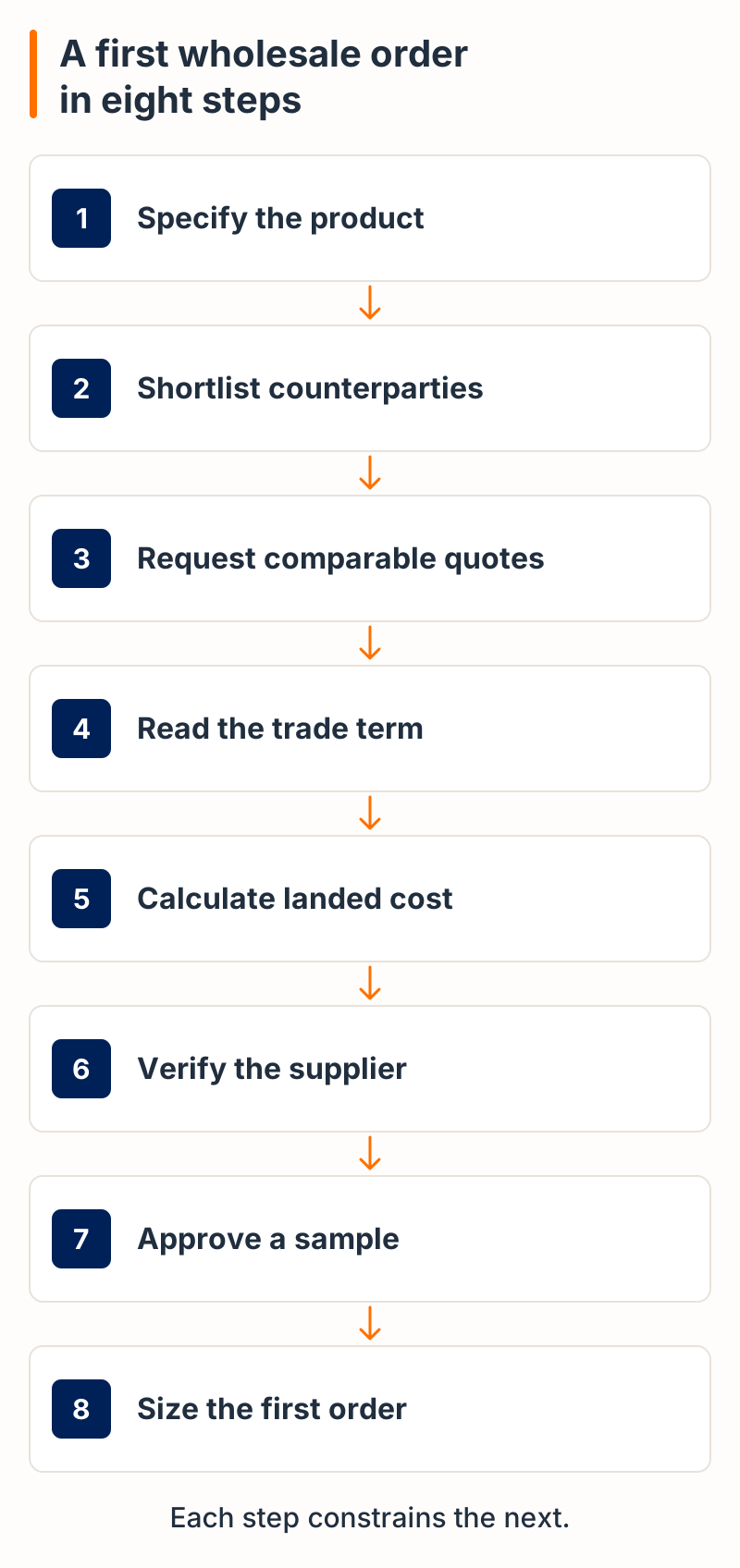
- Specify the product — materials, tolerances, packaging and certification, written before anyone is asked for a price (below).
- Shortlist counterparties — separate manufacturers, traders, wholesalers and distributors first (how to find wholesale suppliers).
- Request comparable quotes — same specification, quantity, trade term and lead time to everyone (how to request a wholesale quotation).
- Read the trade term — EXW, FOB and CIF allocate cost and risk differently (EXW vs FOB vs CIF).
- Calculate landed cost — freight, duty, handling and defects on top of the unit price (how to calculate landed cost).
- Verify the supplier — legal entity, bank account name, trading history, then a facility check (how to verify a wholesale supplier).
- Approve a sample — the approved sample becomes the production standard (below).
- Size the first order — small enough to survive being wrong (how to negotiate MOQ).
Use the tools in order
| Task | Guide or tool |
|---|---|
| Screen one product before you specify it | Wholesale product evidence worksheet |
| Build and screen candidates | How to find wholesale suppliers and the supplier verification checklist |
| Separate eBay stock you hold from supplier shipment | eBay wholesale supply paths |
| Request comparable commercial terms | How to request a wholesale quotation |
| Discuss a smaller first order | How to negotiate MOQ |
| Compare trade-term responsibility | EXW vs FOB vs CIF |
| Estimate the real order cost | Landed-cost guide and the editable cost template |
Write the specification first
If you ask five suppliers to price “a phone charger”, you will receive five prices for five different products. The cheapest will be the one that assumed the least — thinner copper, a lower-grade cell, no retail packaging — and you will not discover which until the goods land.
A specification worth quoting against covers:
- Function and performance. Output, capacity, speed, whatever the buyer actually judges.
- Materials and components. Named grades where they affect cost, not just “high quality”.
- Dimensions and tolerances. Including what variance is acceptable.
- Finish and appearance. Colour references, surface, print method.
- Packaging. Retail packaging, inner cartons, master cartons, labelling, barcodes.
- Certification. Which marks, for which destination market.
This document is also what makes later steps enforceable. Without it, “matches sample” is an opinion.
Domestic versus overseas
The trade-off is rarely just unit price.
| Domestic | Overseas | |
|---|---|---|
| Unit cost | Higher | Lower at volume |
| Minimums | Lower | Higher |
| Lead time | Days to weeks | Weeks to months |
| Iteration speed | Fast | Slow |
| Customs and compliance | Minimal | Importer carries it |
| Recourse if wrong | Practical | Often impractical |
For an unproven product, the speed of the feedback loop usually matters more than the margin. Once demand is established and the specification has stopped changing, the calculation reverses. Compliance obligations fall on the importer regardless — see Basics of importing and exporting.
Making quotes comparable
Send every supplier the same four things fixed, and vary only the supplier:
- Specification. The document above, unchanged.
- Quantity. Ask for the same break points, for example 500 / 2,000 / 5,000.
- Trade term. An ex-works price and a duty-paid price are not the same number. Which term to request is covered in EXW vs FOB vs CIF.
- Lead time. A price at twelve weeks is a different offer from the same price at four.
Then read what came back for what it reveals about the supplier, not only the number. A quote that ignores half your specification tells you how production will go.
Order minimums are the usual friction point, and they move under specific conditions rather than through persistence — the mechanics are in how to negotiate minimum order quantity.
The sample stage
The approved sample becomes the production standard, so it needs to be documented well enough to reject a shipment against.
- Approve against the written specification, not against photographs
- Retain and seal two reference samples, one held by each party
- Record the specific attributes that matter, because a contested sample is worthless
- Agree the inspection standard and who pays for re-inspection
Silent substitution between the approved sample and the production run is the most common quality failure in commodity categories, and it is invisible from the outside.
Sizing the first order
The first order is an experiment, and its job is to be survivable if the answer is no.
- Buy the smallest quantity that still gets you honest terms and a real production run
- Accept a worse unit price in exchange for a smaller commitment
- Hold the balance payment against inspection, not against shipping documents
- Assume at least one iteration on specification before the second order
Sellers who optimise the first order for unit cost frequently end up holding a pallet of a product they now know they should have changed.
Ecommerce sourcing vs physical retail sourcing
The supplier steps are the same. What changes is where the goods go after they land and who sees them before the customer does, and that changes what belongs in the specification.
| Area | Ecommerce seller | Physical retail store |
|---|---|---|
| Packaging | Must survive parcel handling to the customer’s door; size and weight affect shipping cost | Must survive carton or pallet delivery to the store and present well on a shelf |
| Product information | Listing images, dimensions and product identifiers the sales channel asks for | Shelf labelling and in-store display |
| Returns | Customers send items back individually; agree with the supplier how defects are handled | Returns come back through the counter, where the item can be inspected on the spot |
| Where stock is held | Your own storage, a fulfilment provider or a marketplace’s fulfilment programme, each with its own labelling and delivery rules | Store stockroom or a central warehouse |
| Channel rules | Each marketplace sets rules on what may be listed and what documents a seller must hold | Set mainly by the store’s own buying decisions and the law |
Write these into the specification at step 1: carton and inner-pack requirements, labels and barcodes, and the documents your sales channel asks for.
Handmade marketplaces are the clearest case where wholesale stock may not fit at all. Etsy’s Creativity Standards require every item to be made, designed, handpicked or sourced by the seller, and list “resold clothing that is ready-to-use as-is, without further crafting” among items that do not qualify as sourced by a seller. Read the current standards before buying stock for an Etsy shop.
Sourcing, procurement and sourcing agents
As these guides use the terms, sourcing is finding and qualifying suppliers and agreeing terms with them — steps 1 to 7 above. Procurement is the wider buying process, which also covers placing and paying for orders, receiving goods and managing suppliers over time. A small online seller does both; the distinction matters mainly when reading job titles or software descriptions.
A wholesale sourcing agent does the finding and negotiating for you, for a fee. Whether that help is worth it depends on how the agent is paid and who you end up contracting with — the questions to ask are in sourcing agents and sourcing companies.
Where sourcing projects fail
- Specification written after quoting. Everything downstream becomes renegotiation.
- Counterparty never verified. Checks belong before the deposit — see how to verify a wholesale supplier.
- Trade term left implicit. Landed cost turns out to be far above the quoted price.
- Sample approved casually. No enforceable standard when production differs.
- Wrong layer of the chain. Branded goods usually need wholesale distributors; custom goods need a manufacturer. The four supplier types are compared in wholesale suppliers.
Where to go next
If you know what you want to sell, start with how to find wholesale distributors for branded goods, or wholesale suppliers for everything else. For the commercial mechanics of the order itself — pricing, trade terms, landed cost and payment — see buying guides. Category-specific structure is covered under industries.
Frequently asked questions
Should I source domestically or overseas for a first product?
Domestic suppliers cost more per unit but shorten the feedback loop, reduce minimums and remove customs from the first iteration. Overseas suppliers win on unit cost at volume. For an unproven product the faster loop is usually worth more than the margin.
How many suppliers should I request quotes from?
Three to five is enough to see the shape of the market. Beyond that you add administrative load without new information, because the outliers you learn from appear early.
Is a sample order worth paying for?
Almost always. A paid sample buys the standard you will judge production against, and a supplier unwilling to sell one before a large order is telling you something useful about how disputes will go later.
Sources
- Basics of importing and exporting — U.S. Customs and Border Protection
- International Trade Administration — U.S. Department of Commerce
- Incoterms rules — International Chamber of Commerce
- Etsy's Creativity Standards — Etsy Accessed October 6, 2026.