Direct answer
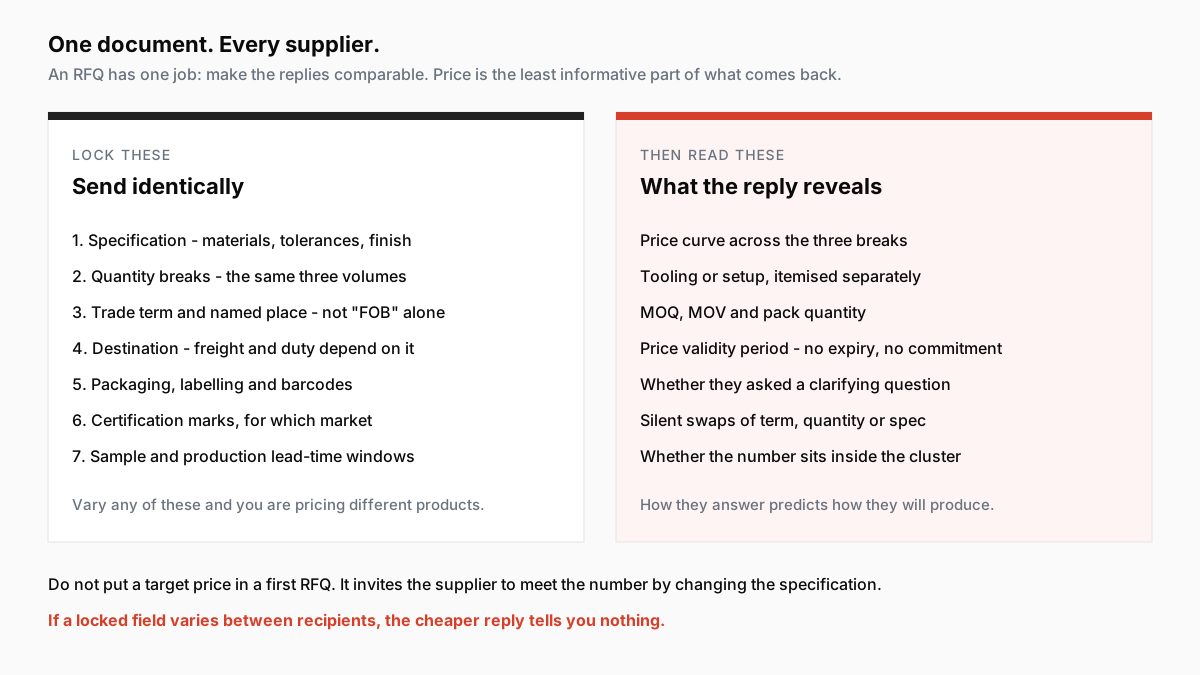
A request for quotation should fix everything except the supplier: specification, quantity break points, trade term, destination, packaging and lead time. Vary any of those between recipients and the replies stop being comparable. Send the same document to everyone, then read the responses for engagement as well as for price.
Key takeaways
- Fix specification, quantity, trade term and destination, or you are collecting prices for different products.
- Ask for quantity break points rather than one quantity, because the curve tells you where the economics change.
- Request the price validity period; a quote with no expiry is not a commitment.
- How a supplier answers the RFQ predicts how they will handle production.
A request for quotation has one job: make the replies comparable. Everything else follows from that. If two suppliers answered slightly different questions, the cheaper number tells you nothing, and you will not discover which question each one answered until the goods arrive.
What to fix before sending
Fix all of these identically for every recipient, and vary only the supplier.
- Specification. Materials, dimensions, tolerances, finish, function. Named grades where they affect cost.
- Quantity break points. Ask for the same three, for example 500 / 2,000 / 5,000.
- Trade term and named place. “FOB” alone is incomplete; it needs a port. See EXW vs FOB vs CIF.
- Destination. Freight and duty depend on it, so a quote without it is provisional.
- Packaging. Retail packaging, inner and master cartons, labelling, barcodes.
- Certification. Which marks, for which market.
- Lead time expectation. So you learn who cannot meet it.
What to ask them to state back
Ask for these explicitly, because their absence is itself informative.
- Unit price at each break point
- Tooling or setup charges, itemised separately from unit price
- MOQ and minimum packaging quantity — see what is MOQ
- Lead time for samples and for production, stated separately
- Payment terms
- Price validity period, which is the line most often omitted
- Country of origin and classification code, both needed for landed cost
A quotation with no validity period is not a commitment. It is a number that can be revised once you have committed elsewhere.
Asking for break points rather than one quantity
Requesting a single quantity gives you a single number. Requesting three gives you the shape of the supplier’s cost curve, which is far more useful:
- A steep drop between break points shows where fixed costs are being recovered, and where the next real negotiation sits
- A flat curve suggests you are buying stock rather than production, or that the trader’s margin dominates
- A supplier who quotes the same price at every volume is not costing your order; they are quoting a list price
Reading the replies
Price is the least informative part of a quotation. What to read for:
- Did they answer the specification, or send a catalogue?
- Did they substitute the trade term or the quantity without saying so?
- Did they ask a clarifying question? This is a positive signal, not a delay.
- Is the price inside the cluster? An outlier far below the group is usually a different specification, not a better supplier.
- Did they state validity and lead time? Omission is a choice.
The supplier who reads the RFQ carefully is the one who will read the production specification carefully. This is the most reliable predictor available at this stage.
After the quotation
A quotation is an offer. Before money moves, ask for a proforma invoice naming the exact goods, quantity, trade term, banking details and validity — and confirm the bank account is in the legal-entity and payment relationship is documented and independently confirmed where details differ. Record the evidence in the supplier verification checklist and follow the process in how to verify a wholesale supplier.
Then convert every surviving quote to landed cost before choosing, because the ranking usually can change: see how to calculate landed cost and use the landed-cost template. To weigh the remaining candidates against your store’s own requirements, record them in the blank supplier selection scorecard.
Where to go next
For the workflow this sits inside, see ecommerce sourcing. For finding the suppliers to send it to, see how to find wholesale suppliers.
Frequently asked questions
Should I tell suppliers my target price?
Generally not in a first RFQ. A target price anchors the reply and invites the supplier to meet it by changing the specification rather than by being efficient. Ask for their price against your specification first, then negotiate.
Should I say how many suppliers I am asking?
It rarely helps and often invites a low first number that is later revised upward once you are committed. Let the specification and the quantity do the work.
What is the difference between a quotation and a proforma invoice?
A quotation is an offer of price and terms. A proforma invoice is the document you act on: it names the exact goods, quantity, trade term, banking details and validity, and it is what a payment should be made against.
Sources
- Incoterms rules — International Chamber of Commerce
- Basics of importing and exporting — U.S. Customs and Border Protection