Direct answer
EXW places nearly all cost and risk on the buyer from the seller's premises onward, FOB transfers risk once goods are loaded at the origin port, and CIF adds the seller's arranged freight and insurance to the destination port. Compare the named place, the applicable Incoterms edition, and the costs not included in each quote before choosing a term.
Key takeaways
- The incoterm allocates cost and risk between the parties; it does not decide ownership or payment timing.
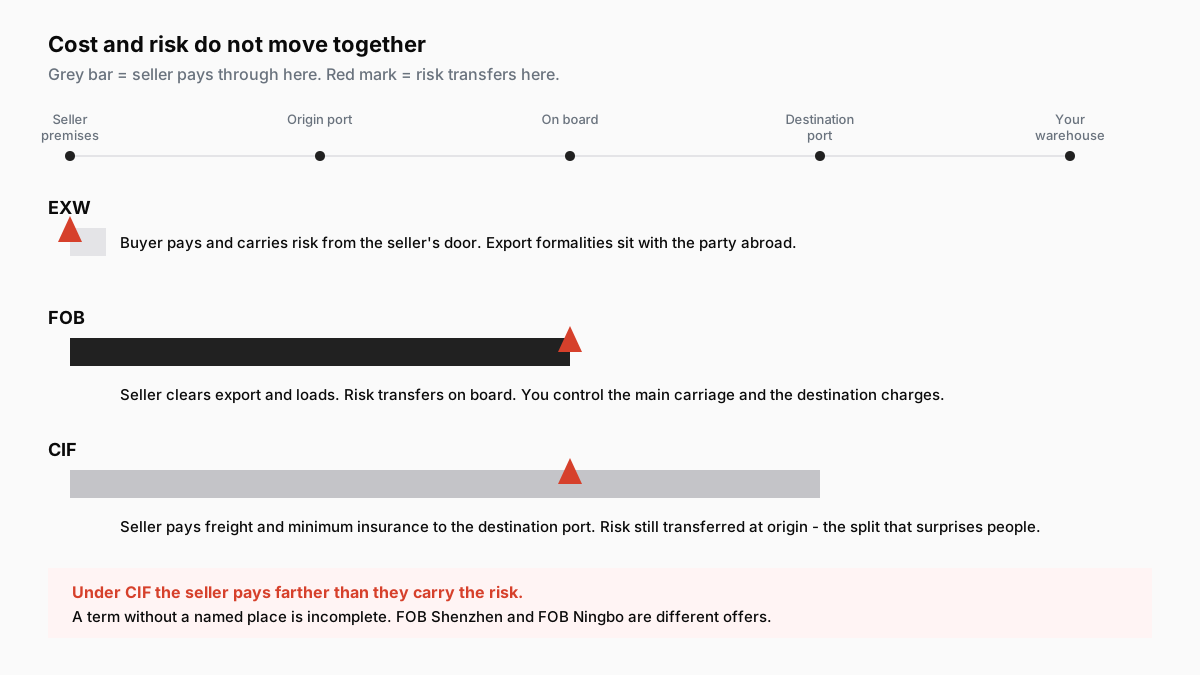
- Under CIF the seller pays freight to destination but risk still transfers at the origin port, so cost and risk do not move together.
- The same shipment can have different quoted prices under EXW, FOB, and CIF while its total underlying costs are similar.
- FOB and CIF are sea or inland-waterway terms; confirm the transport mode and named port fit the transaction.
- A quotation naming a term without a place is incomplete and cannot be compared.
An incoterm answers two questions: who pays for each leg of the journey, and who carries the risk if something goes wrong on that leg.
It does not determine who owns the goods, and it does not determine when payment is due. Those are separate terms in the sale contract, and conflating them is the most common source of confusion in a first import.
The three terms in outline
| Seller handles | Risk transfers at | Buyer handles | |
|---|---|---|---|
| EXW | Making goods available at their premises | Seller’s premises | Collection, export clearance, main freight, insurance, import, delivery |
| FOB | Export clearance and loading on board | On board at origin port | Main freight, insurance, import clearance, duty, delivery |
| CIF | Export clearance, freight and insurance to destination port | On board at origin port | Import clearance, duty, destination charges, delivery |
The bolded cell is the one that surprises people.
FOB and CIF are intended for sea or inland-waterway transport. Confirm the transport mode, named port, and applicable Incoterms edition in the contract. For other modes or containerised shipments, seek advice on whether another rule fits the handover point.
A worked comparison on one basis
The figures below are illustrative only, for the same shipment and route. They show why a lower EXW quote does not automatically mean a lower total cost: each trade term places different costs inside the supplier’s quote.
| Cost element | EXW quote | FOB quote | CIF quote |
|---|---|---|---|
| Goods | $4,000 | $4,000 | $4,000 |
| Origin collection and export handling | $160 | Included | Included |
| Main freight and insurance | $960 | $960 | Included |
| Import, local handling, and delivery | $810 | $810 | $810 |
| Illustrative total | $5,930 | $5,930 | $5,930 |
This is not a price benchmark. Actual charges depend on the route, cargo, customs treatment, and services included. Use the landed-cost template to enter the supplier’s quote and keep estimated and actual charges separate.
Cost and risk do not travel together
Under CIF the seller pays for freight all the way to the destination port. Risk still transfers when the goods are loaded at origin.
If the vessel is delayed, the container is damaged, or the cargo is lost mid-ocean, the buyer needs to understand the risk position even though the seller booked and paid for carriage. Check the agreed insurance scope and claims process rather than assume the cover fits the goods.
This split is central to comparing CIF with the other terms.
When each term can be workable
Under EXW the buyer takes on collection and export-side responsibilities. It can be workable when the buyer’s freight provider can perform those tasks and the responsibilities are clearly agreed.
Under CIF the seller arranges carriage and insurance to the named destination port. Ask in advance which services and destination charges are included, and who will handle import clearance and delivery.
Under FOB the seller handles export clearance and loading on board at the named origin port, while the buyer arranges main carriage and the destination side. It can be practical where that split matches the parties’ capabilities and transport arrangement.
Always name the place
“FOB” alone is not a term. It requires a named port: FOB Shenzhen and FOB Ningbo are different commercial offers, because inland haulage to the port differs.
The same applies to every term. A quotation naming a term without a place is incomplete, and it cannot be compared with any other quotation. Ask for it before doing anything else with the number — see how to request a wholesale quotation.
It is also worth naming the Incoterms edition in the contract, since the rules are revised periodically and definitions have changed between editions.
The two other terms you will meet
DDP — delivered duty paid. The seller takes the stated delivery and import responsibilities. Before using it, confirm the named place, importer-of-record arrangement where relevant, included charges, and the compliance process for the destination market.
DAP — delivered at place. The seller delivers to the named place while the buyer handles the agreed import formalities and duty. Confirm the precise delivery point and unloading terms.
Common mistakes
- Comparing an EXW price against a CIF price. They are not the same number and never will be. Convert both to landed cost first — how to calculate landed cost.
- Assuming CIF insurance is sufficient. Read the agreed insurance scope and claims process.
- Assuming the incoterm moves compliance. Importer-of-record obligations attach to the importer regardless of who pays freight.
- Leaving the term implicit. If it is not written on the proforma invoice, it is not agreed.
Choosing
- You can arrange origin collection and export tasks — compare EXW with the other terms on the same destination-cost basis.
- You want to arrange main carriage — assess whether FOB’s port handover fits the shipment.
- You want the seller to arrange carriage to a port — assess CIF’s included services, insurance, and destination costs.
- You want delivery at a named destination — compare DAP or DDP after confirming importer and compliance responsibilities.
Where to go next
For the full cost picture the term feeds into, see how to calculate landed cost. For the wider order structure — pricing, payment and inspection — see buying guides.
Frequently asked questions
Does the incoterm decide who owns the goods?
No. Incoterms allocate cost and risk for transport and formalities. Ownership passes according to the sale contract and applicable law, and payment timing is a separate commercial term again. These three are frequently conflated and are genuinely independent.
Why is CIF often more expensive than it looks?
The quote may exclude import clearance, duty, local handling, delivery, or charges outside the seller's freight arrangement. Ask for the named port, included services, insurance scope, and a written list of expected destination costs.
Should I ever accept EXW?
Where you already have a freight agent operating in the origin country who can handle export clearance on your behalf, EXW is workable and sometimes cheapest. Without that, you are taking on formalities in a jurisdiction where you have no standing.
What about DDP, where the seller delivers duty paid?
DDP can simplify a purchase when the seller can meet the agreed import responsibilities. Ask who will act as importer of record where relevant, what is included, and how the seller will handle customs and compliance obligations.
Sources
- Incoterms® 2020 — International Chamber of Commerce
- Basics of importing and exporting — U.S. Customs and Border Protection