Direct answer
A wholesale distributor buys in volume from manufacturers and resells to retailers, usually within a defined territory or product line. What separates a distributor from a general supplier is permission: an authorised distributor sells stock the brand has agreed it may sell, within the products, territory and channels the brand set. Calling itself a distributor does not make a company authorised, so verify the scope of the authorisation and confirm warranty, permitted sales channels, marketplace account and product approval, and supply terms separately.
Key takeaways
- Distribution rights are granted by the brand, not bought from a trader, and that permission is what a buyer is really paying for.
- Grey-market stock is usually genuine and often legal to resell, but it typically arrives without warranty pass-through or marketplace brand approval.
- Exclusive, selective and open distribution behave very differently on price, territory and how much competition you will face.
- Distributor terms move on volume and payment risk, but almost never on territory or brand protection rules.
- A distributor is the wrong choice when your volume is below their economics or you need product customisation.
A wholesale distributor is not a supplier with a bigger warehouse. Distributors occupy a defined position in a brand’s route to market, and that position — not their inventory — determines what they can sell you, at what price, and under what conditions.
Sellers who miss this distinction tend to discover it late, usually when a marketplace asks for an invoice from an authorised source and the invoice they hold does not qualify.
What a distributor does for an ecommerce seller
For an online store, a wholesale distributor is the usual source of branded stock that you buy, hold and resell under the brand’s name. What it adds over a general supplier is the brand’s permission, and that permission is what an ecommerce seller tends to need. Each item below is something to confirm with the brand or the distributor, not something the label guarantees:
- An invoice from an authorised source, one of the documents a marketplace may ask for when a brand disputes a listing
- Warranty cover for your customer, if the brand’s warranty terms include products bought through your route
- Repeatable supply of the same products, if the distributor’s supply terms commit to it
A distributor sells you stock. A dropshipping supplier is a different arrangement: it ships orders to your customers from its own stock, so you do not hold inventory, and the questions about authorisation, delivery and returns apply to that supplier instead.
This site is not a distributor. We do not sell goods, hold inventory or appoint distributors, and we do not publish lists of distributors — see about these guides. Authorisation changes, and the brand is the reliable source for who currently holds it.
Start here: find, evaluate, verify
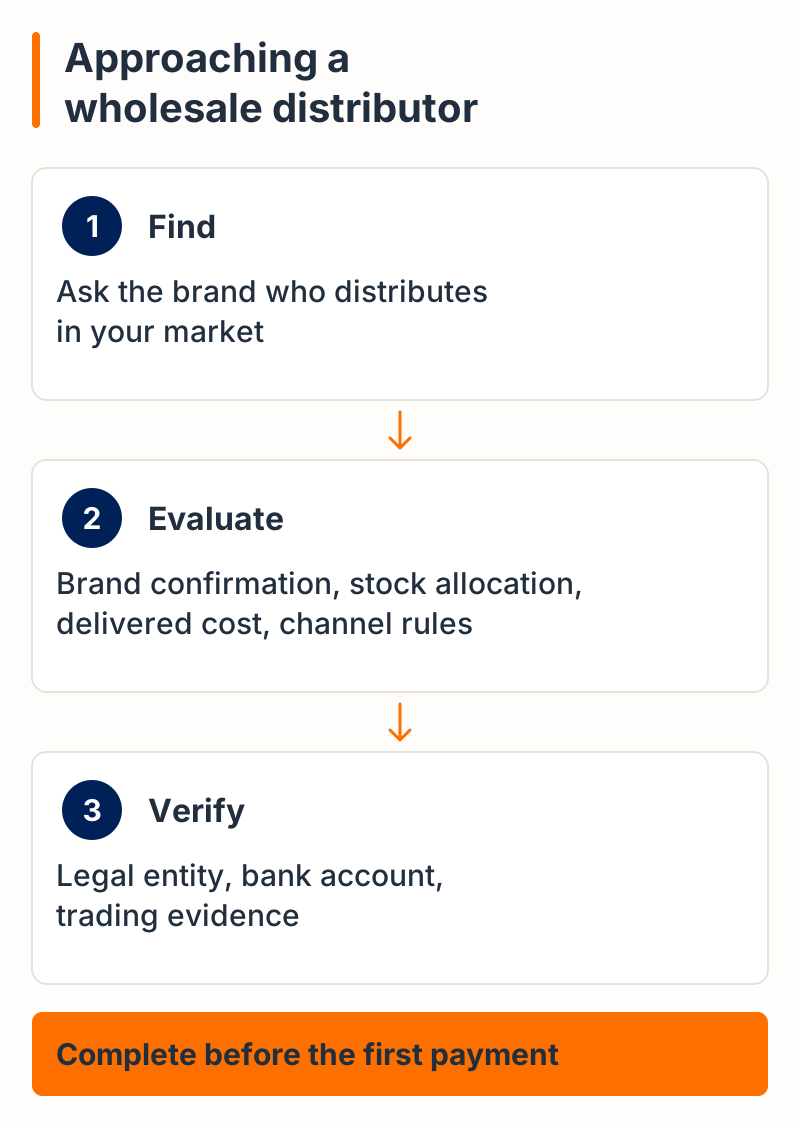
- Find. Start from the brand: ask the manufacturer who distributes in your market. The method is in how to find wholesale distributors.
- Evaluate. Ask whether the brand confirms them, how stock is allocated in a shortage, what the delivered cost is and whether your sales channel is permitted — see how to evaluate a wholesale distributor. When a distributor says it is authorised, check that claim with the brand for your products, territory and sales channel before you rely on it.
- Verify. Check the legal entity, bank account and trading evidence before the first payment — see how to verify a wholesale supplier. The quick registry and payment-name checks take minutes and can run alongside step 2.
If your orders are small, read wholesale distributors for small business first. If the distributor is in another country, see international wholesale distributors.
Where distributors sit in the channel
Most consumer goods reach a retailer through some version of this chain:
| Role | Buys from | Sells to | Holds stock | Sets your cost |
|---|---|---|---|---|
| Manufacturer | — | Distributors, large retail | Yes | Lowest, at highest volume |
| Distributor | Manufacturer | Retailers, resellers | Yes | Tiered by volume |
| Wholesaler | Distributor or manufacturer | Small retailers | Sometimes | Higher, lower minimums |
| Trading company | Anyone | Anyone | Rarely | Variable, opaque |
| Retailer | Any of the above | End customers | Yes | — |
The rows in the middle are where most confusion lives. A “wholesaler” and a “distributor” may describe themselves identically while holding completely different rights. The practical test is not what they call themselves but whether the brand acknowledges them.
For how these roles differ in what they control and what they are accountable for, see manufacturer vs wholesaler vs distributor.
Authorised distribution is a permission, not a purchase
You cannot buy your way into authorised distribution from a trader. The brand grants it, usually against commitments on volume, territory, service capability and sometimes storefront quality.
What authorisation can get you, each to be checked separately:
- Warranty cover. Some brands tie warranty to the source of purchase. Rockwell Automation, for example, says its warranty covers only products bought from an authorised source. Check the brand’s own terms for products bought through your route.
- Marketplace evidence. An invoice from an authorised source is useful evidence when a listing is challenged, but it does not settle the matter on its own. Amazon decides approval to sell per product and per seller account, and lists brand authorisation letters only as a document to prepare where applicable.
- Replenishment. Repeat supply depends on the distributor’s allocation and supply terms, so ask what it commits to in writing. Grey-market stock is opportunistic and can disappear when a product starts selling.
- Recourse. A distributor with a brand relationship has something to lose if they ship you the wrong thing.
What it costs you: volume commitments, price floors, territory limits, and in many cases a minimum advertised price policy that constrains how low you may publicly list.
Grey market, stated plainly
Grey-market goods are genuine products sold outside the brand’s intended channel, usually arbitraged across regions where the same item carries a different price. In many jurisdictions reselling them is lawful, and for some categories the margin is real.
The costs are rarely on the invoice:
- Warranty may not be honoured in your market
- Plug types, manuals, packaging and certification may be wrong for the destination
- Marketplace listings can be suppressed on brand complaint
- Supply is unrepeatable, so you cannot build a category on it
Grey market is a tactic. It is not a supply chain. Category structure varies widely here — consumer electronics is the strictest case.
The three structures you will meet
Exclusive. One distributor per territory. Prices are firmest, competition is lowest, and your access depends entirely on that one relationship. If they will not open an account for you, there is no second door in that territory.
Selective. The brand appoints several distributors against published criteria. This is the most common structure in electronics and tools. Expect to be assessed on your sales channel, not just your order size.
Open. Anyone meeting basic commercial terms may buy. Prices are most competitive and differentiation is hardest, because your competitors have the same cost base.
Identifying the structure before you approach anyone saves considerable time. It also tells you whether price negotiation is realistic or whether you are competing on service instead.
What distributor terms actually look like
Distributor agreements are firmer than general supplier agreements, and the negotiable parts are narrower than most buyers assume.
Usually negotiable
- Volume tiers and the threshold for the next price break
- Payment terms, once you have a payment history
- Freight allocation, especially who nominates the forwarder
- Marketing support and, occasionally, return allowances
Usually not negotiable
- Territory. Selling outside it can terminate the agreement.
- Minimum advertised price, where a policy exists.
- Channel restrictions, including whether marketplace selling is permitted at all.
- Brand protection terms such as listing content and imagery rules.
The last point catches sellers repeatedly. A distributor may happily sell to you while the brand’s agreement forbids the marketplace you intend to list on. Ask the question explicitly and in writing, before the first order rather than after.
Order minimums are the other recurring friction. They usually reflect cost recovery rather than policy, which is why they move under specific conditions — the mechanics are covered in how to negotiate minimum order quantity.
Qualifying a distributor before you commit
Counterparty checks come first, and they are the same checks any supplier warrants: legal registration, a bank account in the registered name, trading history, and references you selected rather than ones you were handed. The full sequence is in how to verify a wholesale supplier.
Beyond that, distributors carry four questions of their own:
- Can the brand confirm them? One email to the manufacturer settles the authorisation question that nothing else can. This is also the fastest route to finding distributors in the first place — see how to find wholesale distributors.
- What is the real landed cost? A distributor quoting ex-works at a lower unit price can easily cost more delivered than one quoting a duty-paid price. Fix the trade term before comparing anything: EXW vs FOB vs CIF.
- How is stock allocated when supply is short? Ask what happened during the last shortage. The answer tells you where you would sit in the queue.
- Who is the importer of record? Compliance obligations attach to the importer, not the seller, and they do not transfer by agreement.
When a distributor is the wrong choice
Distribution is not always the right layer to buy from.
- Your volume is below their economics. A distributor structured around pallet quantities will not serve a seller buying cartons, and forcing it produces bad terms on both sides.
- You need customisation. Distributors sell what the manufacturer made. Private label, packaging changes and specification changes belong upstream — start at ecommerce sourcing.
- The category has no meaningful brand. For commodity goods such as mobile accessories, distribution adds a margin layer without adding protection, because there is no warranty or authorisation worth passing through.
- Margin will not survive the layer. If the distributor’s price plus freight, duty and marketplace fees leaves nothing, the answer is a different product, not a harder negotiation.
Where to go next
Work through how to find wholesale distributors for the practical search method, then run any candidate through the verification sequence in wholesale suppliers. If you are still deciding which layer of the chain to buy from at all, start with ecommerce sourcing.
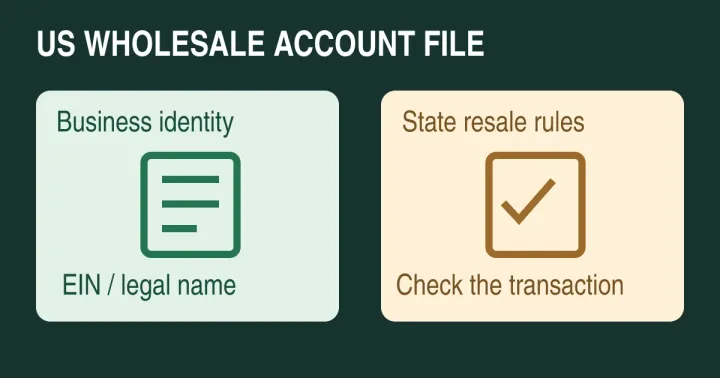
For domestic US accounts, use the US distributor channels and account-document guide to separate territory and online-sales eligibility from EIN, resale-certificate and credit paperwork.
Frequently asked questions
Can I become an authorised distributor myself?
Sometimes, but authorisation is granted against commitments on volume, territory coverage, service capability and often a physical presence. Most ecommerce sellers are better served buying from an authorised distributor than becoming one.
Is grey-market stock illegal to resell?
Generally no. Reselling genuine goods bought legitimately is lawful in many jurisdictions. The practical problems are warranty, certification for the destination market, marketplace brand complaints and unrepeatable supply, rather than legality.
Why would a distributor refuse to quote me?
Most often because your sales channel conflicts with their agreement, your volume sits below their minimum, or your territory is already covered. Asking which of the three applies usually gets an honest answer and saves weeks.
Sources
- Incoterms rules — International Chamber of Commerce
- Business guidance — U.S. Federal Trade Commission
- Basics of importing and exporting — U.S. Customs and Border Protection
- Gray Market and Counterfeit Products — Rockwell Automation Accessed October 11, 2026.
- Categories and products that require approval — Amazon Seller Central Accessed October 11, 2026.