Direct answer
Landed cost is the cost of getting goods to your warehouse, ready to sell. Add goods cost and the costs not already included by the trade term: origin charges, freight, insurance, duty, clearance, and inland delivery. Add financing only when you use it for a decision. Divide the decision cost by the units you expect to sell, not only the units ordered.
Key takeaways
- A quoted unit price does not include every cost needed to compare suppliers or set a selling price.
- Divide by sellable units when defects or losses are material to the decision.
- Keep estimated and actual costs separately so the next order uses evidence rather than an old assumption.
- Two quotes cannot be compared until both are converted to landed cost on the same trade term.
- Duty depends on classification and origin, and the importer of record carries that responsibility.
Landed cost is the total cost of getting goods into your warehouse in sellable condition. It is not the price on a quotation alone. Freight, import charges, handling, and yield can all change the number you use to compare suppliers or set a selling price.
Planning against unit price alone can leave material order costs out of a comparison. Record the assumptions before the order and replace them with actual costs after arrival.
The components
| Component | Notes |
|---|---|
| Unit price × quantity | The only figure most quotes contain |
| Origin charges | Export clearance, documentation, origin terminal handling |
| Freight | Sea, air or courier; varies by route, volume, and mode |
| Insurance | Included under some trade terms, not others |
| Duty and tariffs | Depends on classification code and country of origin |
| Import clearance | Broker fee, entry filing, destination terminal handling |
| Inland delivery | Port or airport to your warehouse |
| Financing | Cost of capital tied up in a deposit for weeks or months |
| Defect allowance | The share of the shipment you expect to write off |
The lines that are not included depend on the route and the trade term. Record them separately so a quote can be compared with another quote on the same basis.
The calculation
Landed cost per unit = Total of all components ÷ Units that arrive sellableThe denominator matters more than it looks. Dividing by units ordered rather than units that arrive sellable understates the true cost of every order that carries a defect rate. If you expect 2 percent unusable and order 1,000, your real denominator is 980.
Download the editable landed cost template. It keeps estimated and actual costs in separate columns and calculates cost per ordered and sellable unit. Enter only costs that are not already included in the trade term. It is not a duty-rate or tax calculator.
A worked shape
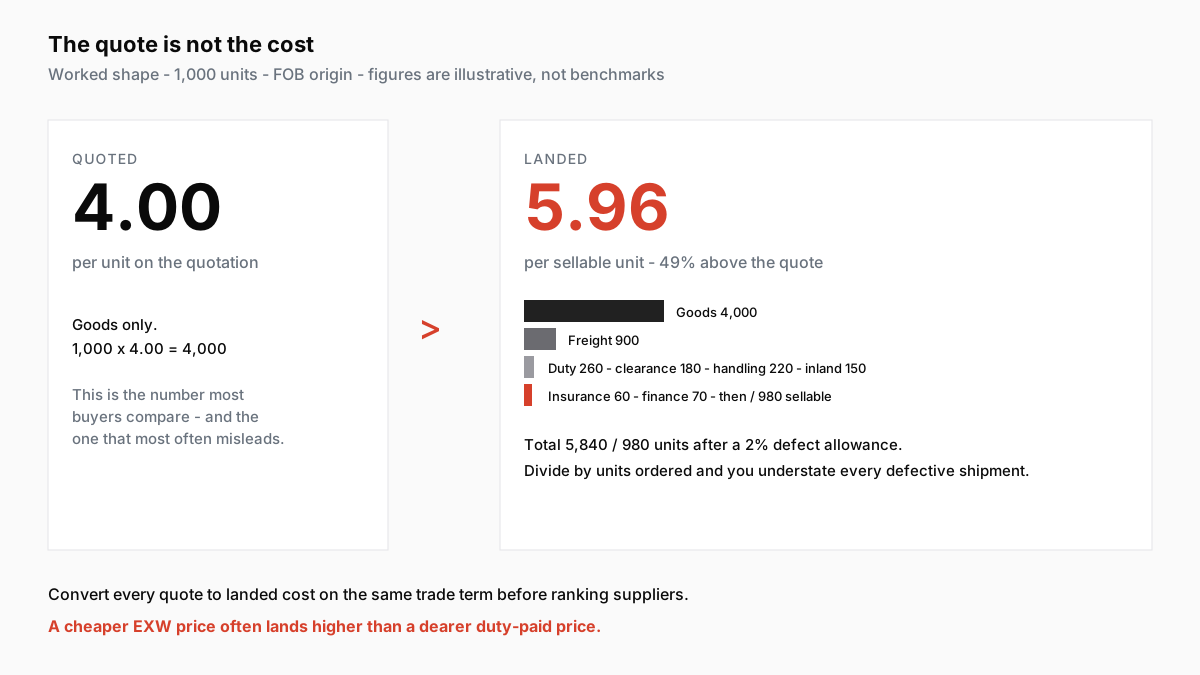
Take an order of 1,000 units at 4.00 per unit, quoted FOB origin port.
| Line | Amount |
|---|---|
| Goods, 1,000 × 4.00 | 4,000 |
| Sea freight | 900 |
| Insurance | 60 |
| Duty | 260 |
| Customs clearance and broker | 180 |
| Destination terminal handling | 220 |
| Inland delivery | 150 |
| Financing, deposit held 10 weeks | 70 |
| Total | 5,840 |
| Sellable units after 2 percent defect | 980 |
| Landed cost per unit | 5.96 |
The quoted price was 4.00. Under these assumptions the cost per sellable unit is 5.96, which is 49 percent higher. The figures are illustrative, not benchmarks. Every line can vary by route, category, volume, trade term, and destination.
Estimate before ordering and record actuals after arrival
An estimate helps you decide whether to place an order. Actual costs help you improve the next one. Keep both in the same structure: goods, origin charges, freight, insurance, import charges, destination handling, delivery, and any documented financing cost.
For the first estimate, leave a cost blank only when you have confirmed it does not apply. After arrival, replace assumptions with invoices, broker statements, and carrier charges. If your actual sellable quantity differs from the estimate, update the denominator as well as the costs.
The trade term changes what is already included
You cannot compare two quotes until both are on the same basis. An EXW price can leave collection and export formalities with the buyer. A FOB price includes different origin responsibilities. A CIF price includes freight and insurance to the destination port but can still leave import, clearance, and inland delivery with the buyer. Confirm the named place and the applicable edition of the trade term before assigning a cost to either party.
First lock comparable RFQ fields, then convert every quote to landed cost before comparing anything. A lower EXW price can land higher than a higher delivered quote once both are expressed on the same basis. The terms are compared in EXW vs FOB vs CIF.
Confirm duty and importer responsibilities
Duty can depend on the classification code applied to the goods and their country of origin. Confirm both for the relevant importer of record and destination market rather than rely only on supplier paperwork.
- Ask for the classification code and the country of origin explicitly
- Confirm the classification with a customs broker or other qualified adviser rather than accepting the supplier’s
- Confirm the compliance obligations for the importer of record and the destination market
Use qualified customs or legal advice where the classification or import obligations are unclear.
Using the number
Once you have landed cost per unit, three things become answerable that were not before:
- Whether the product works at all. Landed cost against realistic selling price, after marketplace fees and returns.
- Which supplier is actually cheaper. On the same basis, which is rarely the same ranking as the quotes.
- Whether volume helps. Freight and duty scale with the order while clearance and documentation largely do not, so the per-unit curve flattens rather than falling forever.
Test the full cost before committing to a larger order to get a lower unit price. A higher volume can spread fixed charges across more units, but it also increases the cash and inventory at risk. That trade-off is covered in what is MOQ.
From landed cost to retail price
Landed cost tells you what a sellable unit cost to put on your shelf. It does not tell you what the unit earns. To test a retail price, add the costs that occur each time you sell, then see what is left.
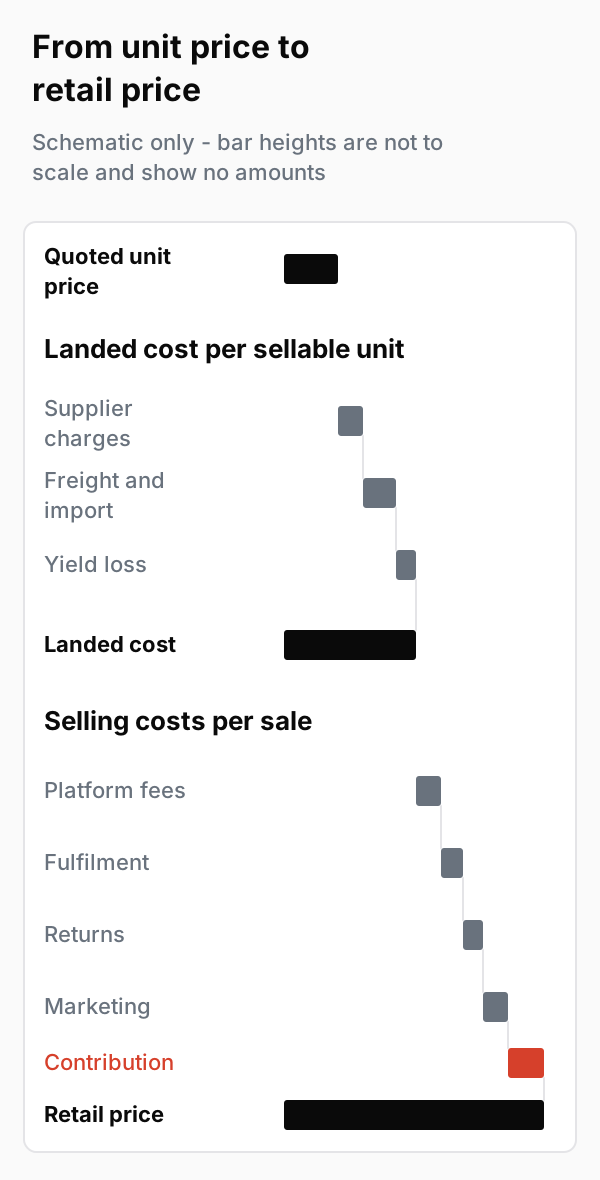
Contribution per unit  =  Retail price
                          − Landed cost per sellable unit
                          − Platform and payment fees per sale
                          − Fulfilment and packing per sale
                          − Returns allowance
                          − Marketing cost per sale
If the result is thin or negative at the price you can realistically charge, a cheaper supplier quote is rarely enough to fix it; recheck the selling price, the fee lines, or the product.
Supplier-side costs that sit outside the unit price
Before the freight and import lines, check whether the supplier charges any of these separately. Each one belongs in the cost sheet as its own line, even when it is zero.
- Samples and sample shipping
- Account set-up, order handling, or small-order surcharges
- Custom packaging, labelling, or barcodes
- Tooling or setup for a custom version
- Payment or bank transfer charges
Columns for a wholesale sourcing cost sheet
Keep one row per cost line and one sheet per order, using these columns:
| Column | What goes in it |
|---|---|
| Cost line | Goods, supplier charges, origin, freight, insurance, duty, clearance, delivery, financing, platform fees, fulfilment, returns, marketing |
| Basis | Per order, per shipment, per unit, or per sale |
| Estimated amount | Your planning figure before ordering |
| Source of estimate | Quote, rate card, official fee page, or assumption |
| Actual amount | The invoiced or charged figure after arrival or sale |
| Variance | Actual minus estimated |
| Per sellable unit | The line total divided by sellable units, or the per-sale amount |
| Included in price? | Yes where a supplier or trade term already covers the cost |
Platform fee rows
Marketplace fees change by category, plan, size, and service, so leave them as placeholder rows until you have looked up the current figures on the platform’s official fee page. On Amazon, for example, the official Sell on Amazon pricing page describes selling plan fees and referral fees, along with fulfilment fees if you use Fulfillment by Amazon and optional costs such as advertising. Enter each as a separate row with the date you checked it, rather than as a single blended percentage.
The landed cost template covers the import side of the sheet. Add the selling rows below it, and keep estimates and actuals in separate columns as you do for the import lines.
Where to go next
Confirm the trade term with EXW vs FOB vs CIF before comparing which costs belong in each quote. For the wider order structure — pricing, payment and inspection — see buying guides.
Frequently asked questions
Should financing cost really be in landed cost?
Include it when it is material to the decision and use the same approach for each option you compare. Keep it as a separate line so that operational cost and financing assumptions remain visible.
How do I estimate duty before I have a shipment?
Duty depends on the classification code and the country of origin, so ask the supplier for both and confirm the classification with a customs broker or other qualified adviser. Confirm the obligation for the importer of record in your destination market.
Do I need cost-sheet software, or is a spreadsheet enough?
A spreadsheet is enough if it keeps estimated and actual costs per order, divides by sellable units, and holds platform fees as separate lines. Consider dedicated software when the number of products, orders, or currencies makes manual updating unreliable.
Why does my landed cost keep coming in above forecast?
Compare the estimate with the invoices line by line. Check whether origin services, destination handling, delivery, duty, exchange rates, financing, or sellable quantity were omitted or changed after the estimate.
Sources
- Basics of importing and exporting — U.S. Customs and Border Protection
- Incoterms rules — International Chamber of Commerce
- How much does it cost to sell on Amazon? — Amazon Accessed October 6, 2026.