Direct answer
Verify a wholesale supplier by recording official registration details, confirming any payment account change through an independently initiated contact channel, checking trading evidence, and reviewing facilities or certificates when the order warrants it. These checks reduce risk; they do not prove that a supplier or product is safe.
Key takeaways
- Use the official business registry in the supplier's claimed jurisdiction and record the evidence you checked.
- A payment-name or bank-detail mismatch calls for written documentation and independent confirmation before payment.
- Treat shipment records, websites, platform badges, and supplier-provided reports as evidence to assess, not proof on their own.
- Verify the counterparty separately from the product specification, sample, and inspection process.
- Run product compliance as its own track and finish it before the deposit; for US consumer products the CPSC names the importer or domestic manufacturer as the certifying party.
Verification is most useful before money moves. Start with the checks that take minutes, record what you found, and decide whether the value and risk of the order justify deeper checks.
The sequence helps you avoid paying for a facility visit when the identity or payment information still needs explanation.
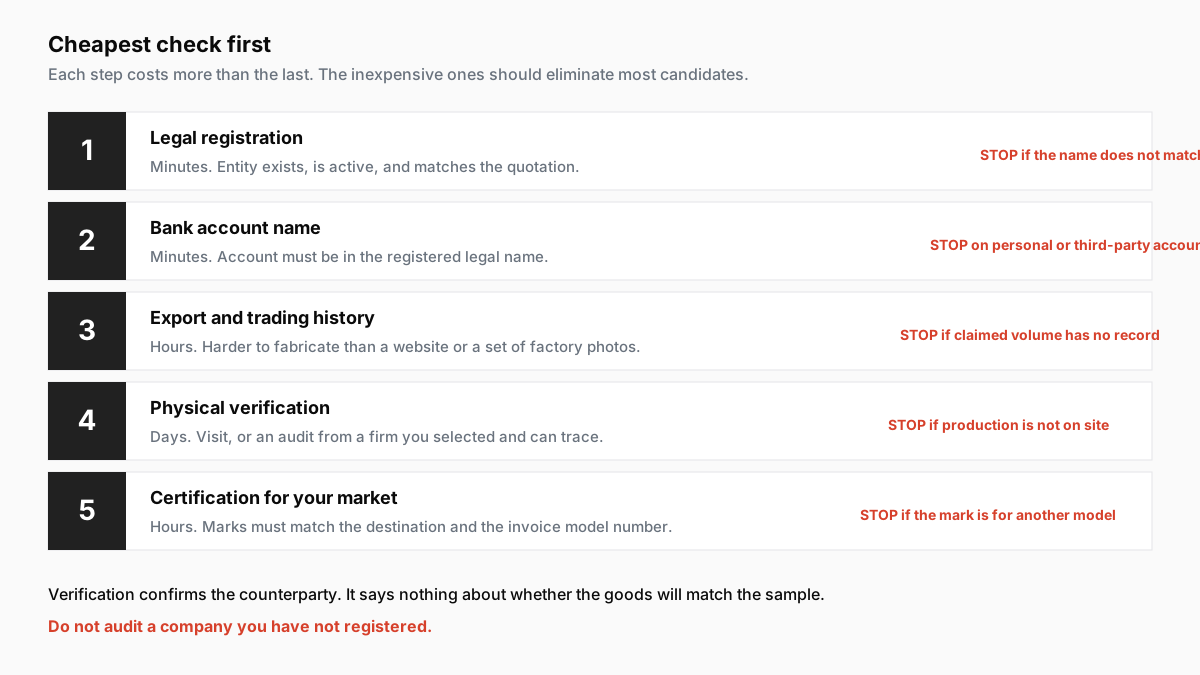
Download the supplier verification checklist. Use it to record the source, date checked, evidence, and decision for each item rather than relying on a collection of screenshots.
1. Legal registration
Confirm the company in the official business registry for the jurisdiction it claims. Compare the legal name, registration number, status, and address with the quotation and proforma invoice.
What you are looking for:
- The entity exists and is active, not dissolved or suspended
- The name matches the one on the quotation and the proforma invoice
- The incorporation date is consistent with the trading history claimed
- The registered address is consistent with the business information you have been given
A trading name can differ from the registered entity. Ask the supplier to document the relationship, then record the legal entity that will sign and invoice the transaction.
2. Bank account name
Compare the account holder named in payment instructions with the legal entity on the quotation and invoice. A difference is not automatically fraud: a group company, payment agent, or trading name may be involved. Ask for written documentation and independently confirm it before payment.
Variations worth stopping over:
- Payment requested to a personal account
- Payment to a third-party company described as an agent or affiliate
- An account in a different jurisdiction from the registered entity, without explanation
- Banking details changed by email partway through a transaction, which is a common compromise pattern rather than an administrative update
For a payment-detail change received by email, call a previously verified number or use a known portal. Do not use the contact information included only in the change message.
3. Trading and export history
When available and legally accessible, shipment records can help test a supplier’s claims about product category, volume, or markets served. Their absence is not proof that no trade occurred: sales can move through intermediaries or be outside the available data.
What it establishes:
- Whether they ship the product category at all
- Whether volumes are consistent with the capacity described
- Whether the trade is recent or historical
- Which markets they already serve, which tells you about certification experience
A supplier claiming years of exports to your market with no visible record is worth a direct question. Record the explanation and seek supporting evidence that is appropriate to the order.
4. Physical verification
Either visit, or commission an audit from a firm you selected. A report supplied by the supplier can be useful evidence, but confirm its issuer, date, scope, and whether it covers the facility and product you are considering.
A useful audit covers:
- That production for your product category actually happens on site
- Capacity consistent with the volumes discussed
- Quality control processes that exist in practice, not only on a wall chart
- Whether the business owns the line or is subcontracting
Where an audit is disproportionate to the order value, a directed video call can provide an additional check. It does not verify every aspect of capacity, compliance, or quality.
5. Certification for your destination market
Confirm certification covers the market you are selling into and the exact model you are buying.
Two failure modes recur, and both involve genuine documents:
- Right document, wrong market. Certified for a region you are not selling in.
- Right document, wrong variant. Model number one character different from yours.
Check against the model number on the proforma invoice rather than the catalogue page. Compliance obligations attach to the importer of record and generally do not transfer by private agreement — see Basics of importing and exporting.
Where product compliance review fits
Steps 1 to 4 check the company. Product compliance checks the goods against the rules of the market you sell into, and it runs as a separate track: start it as soon as you have a model number and a destination market, and finish it before the deposit, because a product that cannot be certified for your market is not worth a factory visit.
For consumer products imported into the United States, the U.S. Consumer Product Safety Commission (CPSC) describes two certificates:
- Children’s products (designed or intended primarily for children 12 or younger) that are subject to a children’s product safety rule need third-party testing. The domestic manufacturer or importer certifies compliance in a written Children’s Product Certificate, based on results from a CPSC-accepted laboratory.
- General-use products that are subject to a CPSC-enforced rule, ban, standard or regulation need a written General Certificate of Conformity, based on testing or a reasonable testing program, and it must be in English.
In both cases the CPSC names the domestic manufacturer or the importer as the party that certifies. A test report from an overseas supplier is evidence you can use, not a certificate issued on your behalf. CPSC guidance also states that, beginning July 8, 2026, importers of most regulated consumer products must electronically file certificates of compliance with U.S. Customs and Border Protection. Check the current CPSC guidance for your product before you rely on a supplier’s paperwork.
Which rules apply depends on the product category. Other agencies regulate other categories, and other countries have their own regimes, so this page does not list requirements by product. Category guides under industries cover the questions specific to each category.
What to collect from the supplier during this track:
- The test report, with the laboratory name, report date, and the standard or rule tested against
- A model number that matches the proforma invoice and the sample, not a related variant
- The scope of the report: which components, colours or sizes it covers
- Who will certify: if you are the importer, the certificate is yours to issue, so decide now whether the supplier’s evidence is enough or whether you need your own testing
Marketplaces can ask sellers for their own documents in addition to legal requirements. Check the current seller policy of each platform you list on and add any document it asks for as an extra row in the checklist.
Evidence to record
For each check, record the source URL or document reference, the date checked, the legal entity or model it relates to, what you found, and the decision it supports. Keep the original quotation, proforma invoice, payment instructions, samples, certificates, and audit scope together with that record. The supplier verification checklist includes these fields and a status for items that need follow-up.
A filled-in example
The example below shows how a completed checklist reads, using the rows and decision options (Pending, Continue, Stop, Escalate) of the downloadable file. The supplier, files and findings are illustrative, not a real case. What matters is the pattern: every row names its evidence, and every row that is not Continue has a next action.
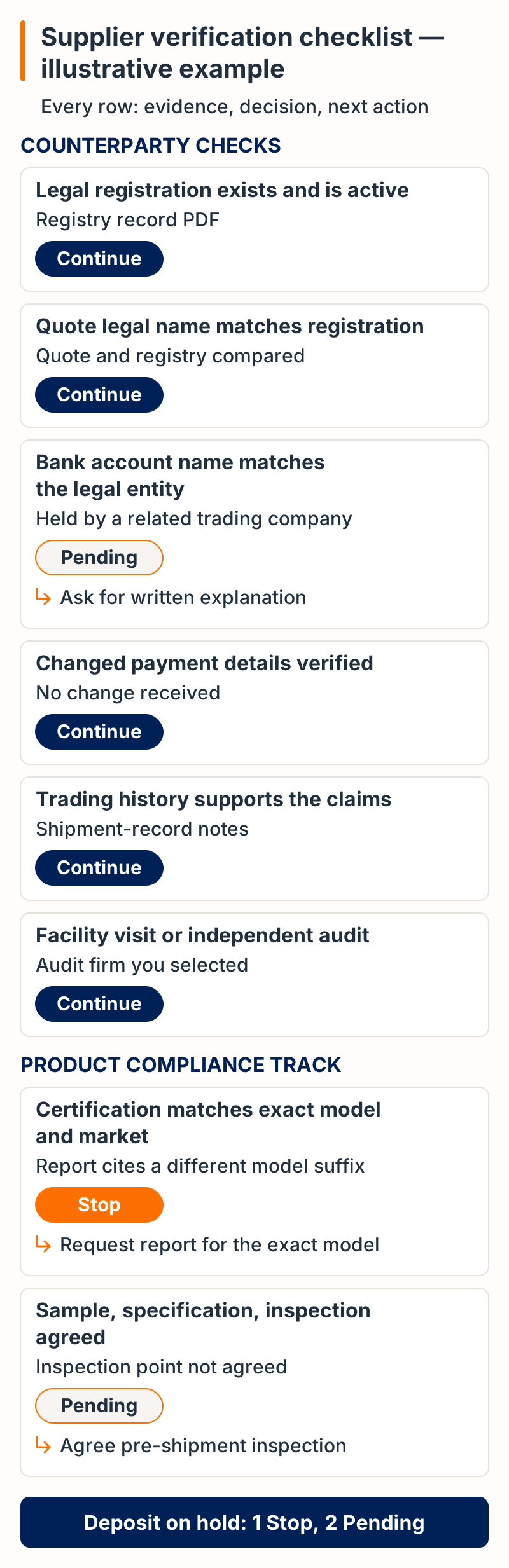
| Check | Evidence recorded | Finding | Decision | Next action |
|---|---|---|---|---|
| Legal registration exists and is active | Registry record, saved as PDF with the date checked | Active | Continue | None |
| Quote legal name matches registration | Quotation and registry record side by side | Names match | Continue | None |
| Bank account name matches the legal entity or has a documented explanation | Payment block on the proforma invoice | Account held by a related trading company | Pending | Ask for a written explanation of the relationship |
| Changed payment details verified through a known contact channel | Call log to the number already on file | No change received so far | Continue | Re-check if details change |
| Trading history supports the claimed product category and markets | Shipment-record search notes | Category and markets consistent with claims | Continue | None |
| Facility visit or independently commissioned audit reviewed | Report from an audit firm you selected | Production for this category seen on site | Continue | Keep the report scope with the record |
| Certification matches the exact model and destination market | Supplier test report | Report cites a different model suffix | Stop | Request a report for the exact model, or plan your own testing |
| Sample, specification, inspection point, and remedy agreed separately | Signed specification; sealed sample | Inspection point not yet agreed | Pending | Agree pre-shipment inspection before production |
In this example the deposit waits: one row is Stop and two are Pending. Change a decision only when new evidence is attached, and keep the earlier entry rather than overwriting it.
What verification does not cover
Verification establishes the counterparty. It says nothing about the goods.
A well-registered, audited, long-trading factory can still ship product that does not match your specification. Those are separate controls: a written specification, an approved and retained sample, and a pre-shipment inspection standard agreed before production starts. That sequence is in ecommerce sourcing.
It also says nothing about which role the business occupies. A verified trading company is still a trading company, and pricing a deal on factory-direct assumptions will still be wrong — see manufacturer vs wholesaler vs distributor.
When to re-verify
Treat verification as a record that may need updating. Re-run the relevant checks when:
- Banking details change, for any reason
- The legal entity on the invoice changes
- Your main contact changes and the new one is unfamiliar with prior terms
- Capacity suddenly increases beyond what the audit supported
- You have not ordered for a long enough period that the business may have changed hands
Where to go next
For where verification sits in the wider selection process, see wholesale suppliers. For finding candidates to verify in the first place, see how to find wholesale suppliers. For distributors specifically, where authorisation is an additional question, see how to evaluate a wholesale distributor.
Frequently asked questions
What should I check before payment?
Check the official registration record, the legal name on the quotation and invoice, and the payment instructions. If details differ, pause and confirm the reason through contact details you obtained independently of the payment-change message.
Do I need to verify a supplier found on a large B2B platform?
Yes. A platform profile can help you identify a candidate, but its badges and rankings do not replace checks on the exact entity, payment instructions, goods, and transaction.
How often should I re-verify an existing supplier?
Whenever something structural changes. New banking details, a change of contact person, a new legal entity on the invoice, or a sudden capacity increase all warrant re-checking rather than relying on history.
Is a video call a substitute for an audit?
A live video call can answer some basic questions, especially when you request specific areas or documents. For a large or regulated order, decide whether an independent audit or inspection is proportionate to the risk.
Sources
- Basics of importing and exporting — U.S. Customs and Border Protection
- International Trade Administration — U.S. Department of Commerce
- Children's Product Certificate (CPC) — U.S. Consumer Product Safety Commission Accessed October 6, 2026.
- General Certificate of Conformity — U.S. Consumer Product Safety Commission Accessed October 6, 2026.