
Direct answer
A manufacturer makes the goods and controls specification. A distributor holds authorised stock for a brand within a defined territory and controls access. A wholesaler resells in bulk without those brand rights and controls availability. The practical difference is not size but what each one can actually promise you when something goes wrong.
Key takeaways
- The useful question is not what a business calls itself but what it controls and what it can be held to.
- Manufacturers control specification, distributors control access, wholesalers control availability.
- Buying further upstream lowers unit cost and raises minimums, commitment and lead time in the same move.
- Only an authorised distributor can reliably pass manufacturer warranty through to your customer.
- A trading company is a fourth role that owns nothing and is often mislabelled as a manufacturer.
- A sourcing agent, fulfilment provider, forwarder or marketplace provides a service; check who actually sells you the goods.
These three words get used interchangeably by the businesses themselves, which is the root of most of the confusion. A company calling itself a “wholesale distributor” may be a factory, a brand’s appointed agent, or a trader with a website and no inventory at all.
The way out is to stop asking what a business is called and start asking two questions: what does it control, and what can it be held to?
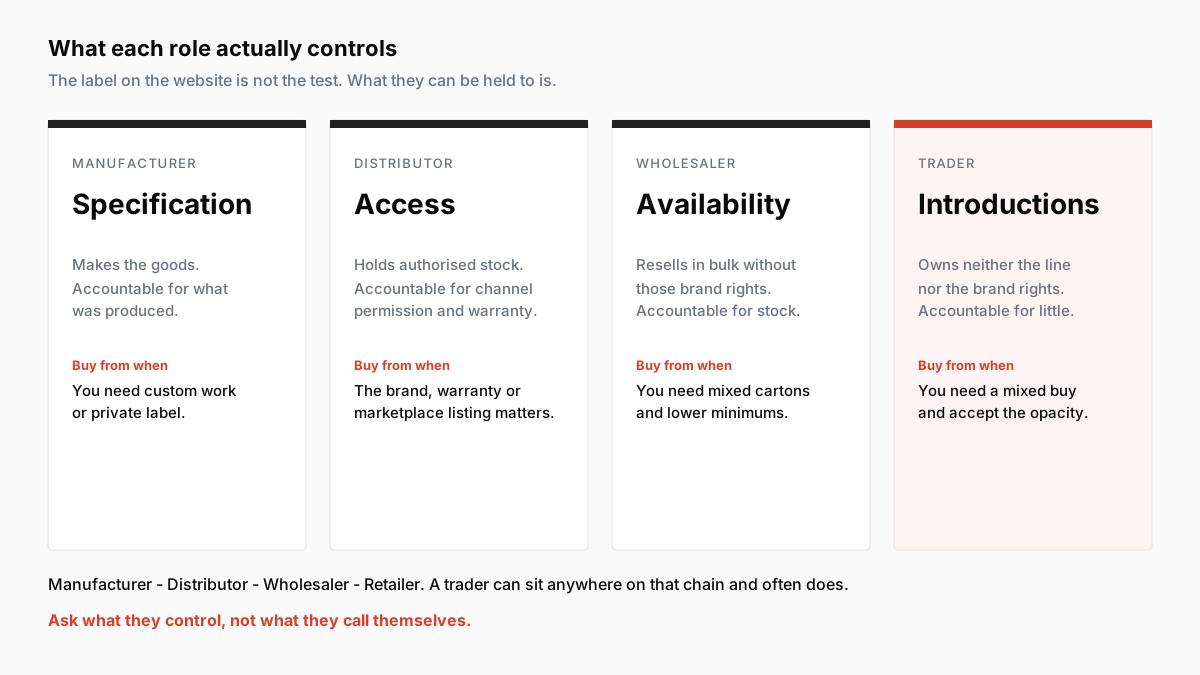
What each role controls
| Makes the goods | Holds stock | Brand rights | Sets specification | Accountable for | |
|---|---|---|---|---|---|
| Manufacturer | Yes | Yes | Own products | Yes | Production quality |
| Distributor | No | Yes | Yes, by agreement | No | Channel and warranty |
| Wholesaler | No | Usually | No | No | Availability and condition |
| Trading company | No | Rarely | No | Passes yours on | Whatever the contract says |
Read that table by column rather than by row. Specification control sits only with the manufacturer. Brand rights sit only with the distributor. No amount of negotiation moves either one to a counterparty that does not have it.
Manufacturer: controls what the product is
A manufacturer owns production. That makes it the only party that can change the product — materials, tolerances, packaging, private label — and the only one that can be held to a specification rather than merely pass it along.
What you get: the lowest unit cost, and the ability to make the product yours.
What it costs: high minimums, tooling charges for anything custom, long lead times, and a rigid relationship. Manufacturers are structured around production runs, so a small mixed order is expensive for them to accept and priced accordingly.
Buy here when the product needs to be different from what already exists, or when your volume genuinely justifies a production run. The workflow is in ecommerce sourcing.
Buying direct from a manufacturer: the steps
Going to the factory makes sense when the product has to be yours or your volume can fill a production run. The order of the steps matters because each one sets up the next:
- Confirm you need a manufacturer. If you would sell an existing branded item unchanged, a distributor or wholesaler is the right counterparty and the factory will often refer you to one anyway.
- Write the specification. Materials, dimensions, tolerances, packaging and the markets you will sell in. A manufacturer can only be held to what is written down.
- Find candidate factories through trade fairs, B2B platforms and industry directories — see how to find wholesale suppliers.
- Confirm it is the factory. Registration, payment account and a facility check establish whether you are talking to the producer or an intermediary — see how to verify a wholesale supplier.
- Request quotes on identical terms — the method is in how to request a wholesale quotation.
- Approve a sample against the written specification and keep a sealed reference.
- Agree the minimum and the first order. Minimums reflect the factory’s costs; what moves them is covered in how to negotiate MOQ.
- Fix the inspection point and remedy before production starts, not after the goods ship.
The drawbacks of buying direct
The lower unit price is paid for in other ways. Weigh these before choosing the factory route:
- Higher commitment. Minimum order quantities and any tooling or setup charges are committed before you know how the product sells.
- Longer lead times. You wait for a production run, then for shipping if the factory is overseas.
- You own the specification. If the specification is incomplete, the factory can meet it and still deliver a product you cannot sell.
- More coordination. You handle communication, samples, inspection and logistics that an intermediary would otherwise take on.
- Importer obligations. When you import, compliance obligations generally sit with the importer of record, not the factory.
- Harder recourse. A dispute with an overseas factory is slower and costlier to resolve than one with a domestic counterparty.
Distributor: controls whether you may buy at all
A distributor buys in volume from a manufacturer and resells to retailers within a defined territory or product line. Its distinguishing feature is not inventory — it is permission.
That permission is what makes these possible:
- Manufacturer warranty honoured for your customer
- An invoice that resolves a brand complaint on a marketplace
- Allocated stock during a shortage rather than opportunistic supply
None of these can be bought from a counterparty the brand has not appointed. The structures, terms and qualification checks are covered in wholesale distributors.
Buy here for branded goods you intend to sell as branded goods.
Wholesaler: controls availability
A wholesaler resells in bulk without the brand relationship a distributor holds. In practice this means lower minimums, mixed assortments, faster access — and no warranty pass-through, no territory protection and no defence if a brand challenges your listing.
Wholesalers are genuinely useful for testing demand, filling gaps and buying across brands in one order. They are a poor foundation for a product line you intend to scale, because their supply is as opportunistic as yours.
Trading company: the fourth role nobody lists
The role most often mislabelled. A trading company brokers other people’s production. It owns no factory and usually no stock.
This is not inherently a problem. A trader that consolidates six factories into one shipment, handles communication and accepts smaller volumes is solving a real problem, and paying for that service is rational.
The failure is pricing a deal on factory-direct assumptions and discovering the intermediary afterwards. Two consequences follow: the margin you thought you were getting is shared, and when a shipment fails inspection the trader’s remedy is to ask the factory, while yours is to ask the trader.
Establishing which you are dealing with is the point of how to verify a wholesale supplier.
Sourcing agents and sourcing companies
A sourcing agent finds factories, negotiates and follows production on the buyer’s behalf. The difference from a trading company is whose side it is on: a trading company sells you goods and earns its margin on them, while an agent is meant to represent you and is paid for a service.
That difference holds only if the money confirms it. Fee structures vary, so ask in writing:
- How is the agent paid, and does it receive anything from the factories it recommends?
- Who signs the purchase contract and who receives your payment: you and the factory, or the agent?
- Who is accountable if goods fail inspection, and what will the agent do about it?
- Will you know the factory, so that you can verify it and order directly later?
An agent paid by the factory, or one that invoices you for the goods, is commercially closer to a trading company. Price and verify it as one. Checks on the businesses the agent introduces are the same as for any supplier.
Roles that are not suppliers
Several businesses in an ecommerce supply chain handle your goods or your orders without selling the goods to you. Treating them as suppliers puts accountability in the wrong place.
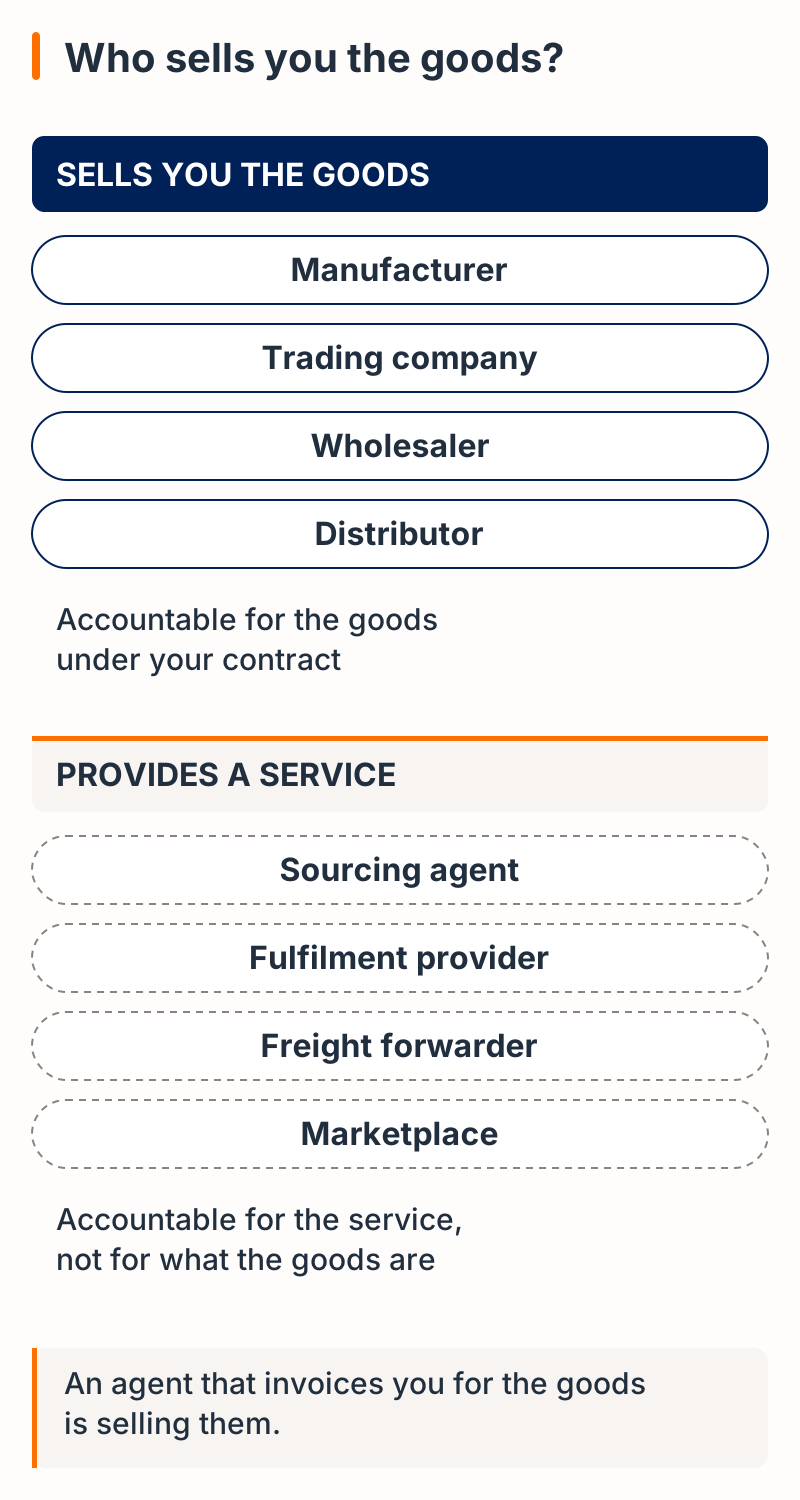
- Fulfilment providers store and ship stock you already own. They are accountable for storage and handling under their service terms, not for what the goods are.
- Freight forwarders move shipments and arrange transport documents. They do not answer for quality or specification.
- Marketplaces host listings and process sales. A storefront on a marketplace belongs to the seller behind it, which is the entity to identify and verify.
- Sourcing agents, as above, provide a service unless they sell the goods themselves.
The test is the same as for every role on this page: who sells you the goods, and what can that business be held to if they are wrong?
Choosing by what you need, not by what is cheapest
Move upstream and unit cost falls while minimums, commitment and lead time all rise together. They are the same movement, not separate trade-offs.
- Branded goods, resold as branded — authorised distributor. Warranty and marketplace defensibility come with the channel and cannot be added later.
- Your own product — manufacturer. Nobody downstream can change the specification.
- Testing demand across brands — wholesaler. Accept the limits deliberately.
- Mixed or low-volume overseas orders — trading company, priced as the service it is.
- Commodity goods at volume — manufacturer, once the specification has stopped changing.
A useful check before committing: ask what happens if a shipment is wrong. The answer maps directly onto which role you are actually dealing with, and it is more informative than any description a supplier gives of itself.
Where to go next
For the distributor side in detail, see wholesale distributors. For the verification sequence that establishes which role a counterparty really occupies, see wholesale suppliers. For the commercial mechanics once you have chosen, see buying guides.
Frequently asked questions
Is buying direct from a manufacturer always cheapest?
Per unit, usually. In total, often not. Manufacturer minimums, tooling costs, longer lead times and the working capital tied up across them frequently exceed the saving for a seller who is not yet moving consistent volume.
Can one company be more than one of these roles?
Yes, and many are. A manufacturer may distribute its own products directly, and a distributor may commission private-label production. This is why the label matters less than establishing what they control for the specific goods you are buying.
Which role should a new ecommerce seller buy from?
For branded goods, an authorised distributor, because warranty pass-through and marketplace defensibility come with the channel. For unbranded or private-label goods, a manufacturer or a trading company, depending on whether you need one product or a mixed shipment.
Sources
- Business guidance — U.S. Federal Trade Commission
- Basics of importing and exporting — U.S. Customs and Border Protection