
Direct answer
Distributors serve small buyers when the account costs little to service and shows signs of growing. That means arriving with a specific product list, realistic volumes, a working business identity and clean paperwork. Below a distributor's economics the honest answer is to use a wholesaler or a stocking reseller until volume justifies the account.
Key takeaways
- Distributors decline small accounts on servicing cost, not on order size alone.
- Arriving with a specific product list rather than a general enquiry changes the reception materially.
- Ordering fewer lines more often is usually better received than one scattered order.
- Below distributor economics, a wholesaler is the correct answer rather than a harder negotiation.
- Being declined for channel reasons is not the same as being declined for size, and the difference is worth asking about.
Small buyers usually assume distributors decline them over order size. More often the reason is servicing cost: an account that generates questions, small frequent shipments and credit administration but little revenue is unprofitable at any order size, and experienced distributors recognise the pattern quickly.
That framing is useful, because servicing cost is something you can change.
What makes a small account worth serving
- A specific product list. Naming models and quantities lets a distributor size the opportunity in a minute. “Please send your price list” does not, and is the most common reason an enquiry goes unanswered.
- Realistic volumes. Overstating projections is transparent and costs credibility that is hard to recover.
- Clean paperwork. Registered entity, bank account in that name, tax registration where required. Anything missing is friction on their side.
- A visible sales channel. A live storefront with the category already selling says more than any projection.
- Low-touch behaviour. Consolidated orders, prompt payment, few exceptions.
How to approach one
Lead with the specific and follow with the general, which is the reverse of what most enquiries do.
A first message that works names the products, states current or expected monthly volume, gives your sales channel, confirms your business is registered, and asks two questions: what the minimum to open an account is, and whether your channel is permitted.
That last question matters more than it appears. Willingness to sell and permission to list are different things, and a distributor may not volunteer the difference — see how to evaluate a wholesale distributor.
For finding the right distributor to approach at all, the route runs through the brand: how to find wholesale distributors.
Making a small order look like a good account
- Fewer lines, more often. Depth on a small number of products reads as a real business. Scattered singles read as a hobby.
- Take stock configurations. Standard colours and packaging cost the distributor nothing to supply.
- Pay early on the first orders. Payment history is the fastest route to better terms, and the cheapest thing you can offer.
- Batch your questions. Servicing cost is what you are managing.
None of this changes the price on the first order. It changes whether there is a second one on better terms.
Choosing a vendor you can actually open an account with
Lists of the “best” wholesale vendors for small business rank on criteria that rarely match your order. Judge each candidate on terms you can check before the first order instead.
| Criterion | What to ask or check | Why it matters at small volume |
|---|---|---|
| Minimums and how they apply | MOQ, minimum order value, and carton quantity, and whether each applies per item, per order, or per shipment | A per-item minimum across five items is a very different commitment from a per-order minimum |
| Account requirements | The documents needed to open a trade account, and whether any apply in your state or country | Missing paperwork stops the account before price is discussed |
| Mixed orders | Whether items, colours, or sizes can be combined to reach the minimum | Combining lines lets you test several products without overcommitting to one |
| Stock or made to order | Whether the items ship from held stock, and from where | Held stock shortens lead time and lets you reorder in smaller steps |
| Channel permission | Whether your marketplace or storefront is allowed for each product | A vendor willing to sell may still not permit your channel |
| Payment terms | Deposit, payment timing, and when trade terms become available | Your cash is tied up until the goods sell |
| Defects and returns | How a damaged or wrong item is reported and resolved | Small orders leave little margin to absorb an unresolved defect |
| The business itself | Legal entity, trading history, and the role it plays in the supply chain | A listing or badge on a platform does not verify the counterparty |
The counterparty checks are in how to verify a wholesale supplier. How minimum order quantity, minimum order value, and carton quantity interact is explained in what is MOQ.
If your order is below the minimum
Compare the quantity you can sell with the vendor’s minimum before you write, because the gap decides the route rather than your negotiating effort.
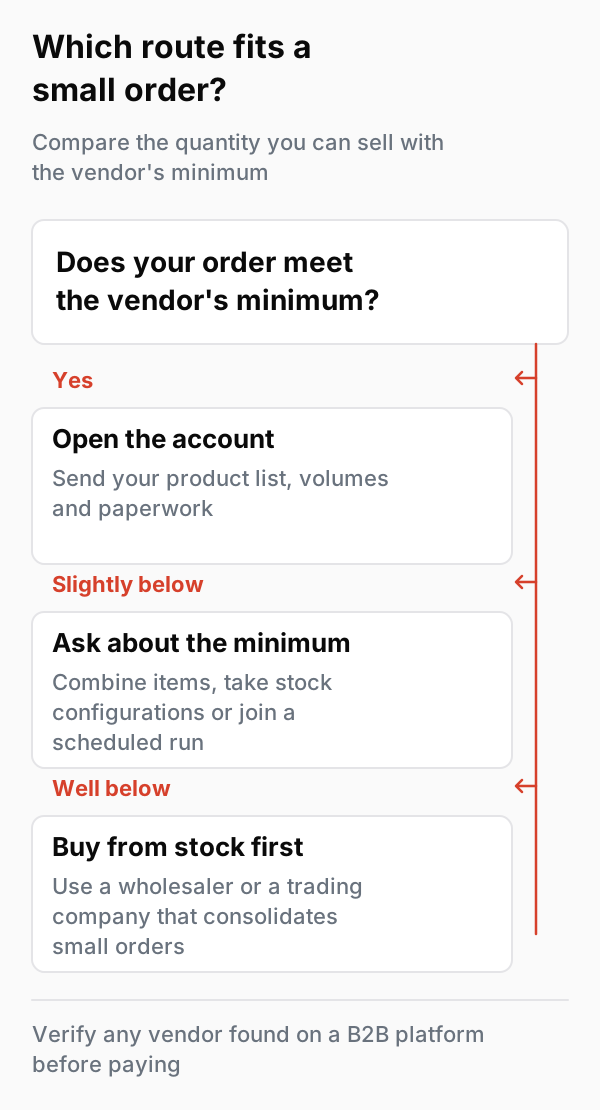
- At or above the minimum: apply for the account with your product list, volumes, and paperwork, as described above.
- Slightly below: ask whether the minimum can be met by combining items, by taking stock configurations, or by joining a scheduled run. The levers and what each costs you are in how to negotiate MOQ.
- Well below: buy from a wholesaler selling from stock, or from a trading company that consolidates small orders across factories. Expect a higher unit price and keep the order records, because they show the volume you will need when you return to the distributor.
A B2B platform can help you find the second and third kinds of vendor, but treat a platform listing as a lead to verify rather than as a verified supplier.
When a distributor is the wrong answer
If you are genuinely below their economics, pushing harder produces bad terms rather than access. The correct structure at that stage is a wholesaler.
You will pay more per unit and get no warranty pass-through or territory protection, but you will get lower minimums, mixed assortments and immediate availability — which is what an unproven product line actually needs. The trade-offs are compared in manufacturer vs wholesaler vs distributor.
Move to a distributor when volume makes the minimum a reasonable rather than a large bet, and when warranty pass-through starts mattering to your customers.
Distinguish the two rejections
If you are declined, ask which it was:
- Size. Solvable with time and volume, and worth revisiting later.
- Channel. Not solvable by growing. If the brand forbids your marketplace, no volume changes that, and you need either a different channel or a different product.
Most distributors will answer honestly if asked directly, and the answer saves months of pursuing the wrong door.
Where to go next
For the structures behind these decisions, see wholesale distributors. For how minimums are set and what moves them, see what is MOQ.
Frequently asked questions
What do I need before approaching a distributor?
A registered business, a bank account in that name, tax registration where your jurisdiction requires it for trade accounts, a working sales channel you can point to, and a specific list of the products you want. General enquiries with no product list are the most common reason for no reply.
Why did a distributor ignore my enquiry?
Usually because the enquiry gave them no way to size the opportunity. A message naming specific models and realistic monthly volumes gets answered far more often than one asking for a price list.
What should I do if I am below every distributor minimum?
Buy from a wholesaler while you build volume. It costs more per unit and provides no warranty pass-through, but it is the correct structure for your stage rather than a compromise.
Sources
- Business guidance — U.S. Federal Trade Commission
- International Trade Administration — U.S. Department of Commerce