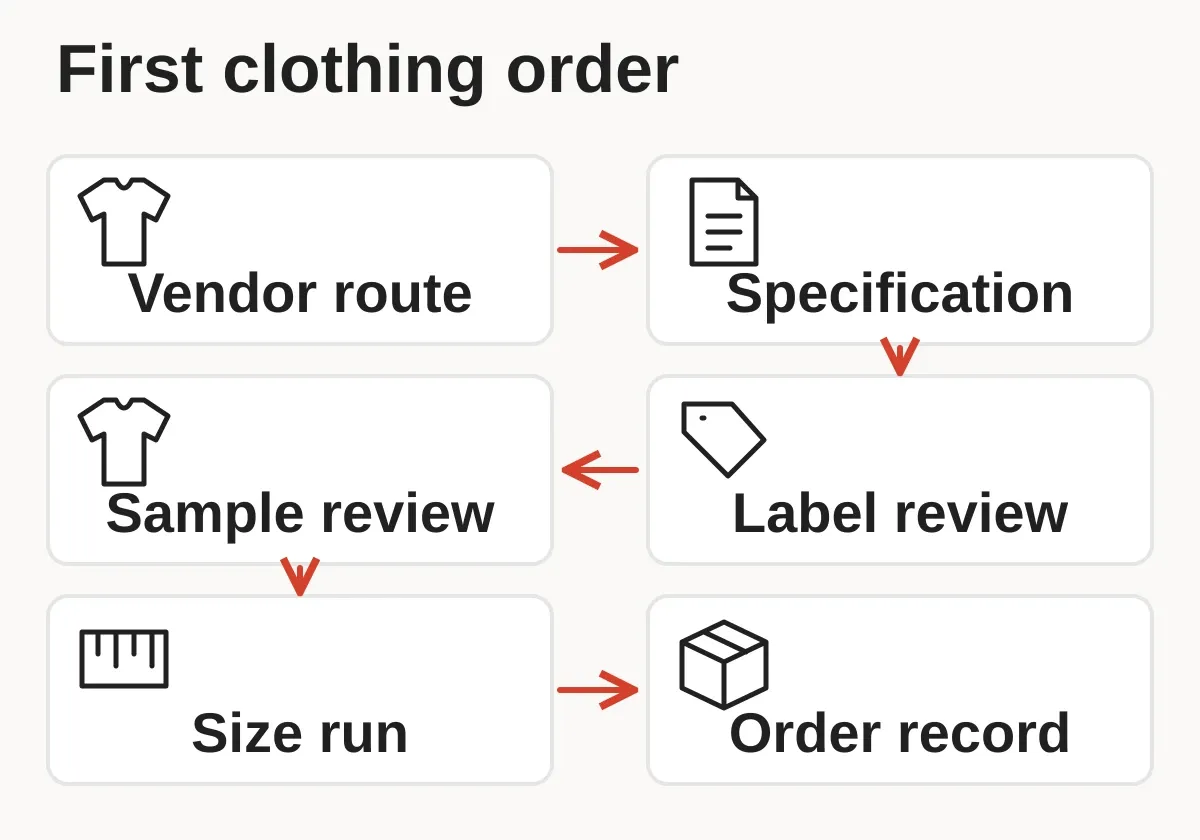
A clothing order can tie up cash in garments that look right online but arrive in the wrong fit or size mix. Start by matching the vendor’s offer to your order, then compare a written garment specification, labels, samples and quantities before paying for bulk stock.
If you searched for wholesale clothing vendors, this guide helps you move from a candidate website or showroom contact to a documented first order for a US online store. It supplies fields to fill and questions to resolve, rather than a supplier list. The steps below are editorial purchasing recommendations; the regulatory checks link to their government sources.
Quick Specs: inputs to collect before comparing offers
| Input or item | Typical value or source | Why it matters |
|---|---|---|
| Order route | Seller’s stock list or production proposal | Separates existing goods from future production |
| Style and color | Exact seller identifiers and current photos | Connects the quote to the garment being reviewed |
| Fabric and weight | Supplier specification; weight in g/m² where available | Makes material descriptions comparable |
| Size chart | Garment measurements, units and measuring method | Gives a basis for checking fit claims |
| Labels and documents | Label artwork and applicable product records | Reveals gaps before bulk approval |
| Size quantities | Available pack contents or your own sales evidence | Exposes the sizes and cash committed by the order |
Match the vendor route to your order
Choose the route by what you need to buy: available garments, access to a collection, or a garment made to your specification. Finding a contact is only the beginning; each candidate needs to provide evidence for the actual offer.
Start with a defined garment category and intended customer. A search for a broad category can produce websites offering very different transactions. Add the order form you want — existing stock, a future collection delivery or custom production — to the request you send. Use product and trade-event directories, showroom contacts, manufacturer enquiries and wholesale catalogues as discovery channels, then ask who owns the selling relationship.
| Candidate route | Ask before requesting a sample | Record for the comparison |
|---|---|---|
| Stocking wholesaler | Which styles, colors and sizes are available for this order? | Dated availability list and exact pack contents |
| Brand or showroom contact | Who accepts the order and invoices it; is delivery current or future? | Selling entity, collection/style references and delivery terms |
| Manufacturer | Is this an existing design or production against a buyer specification? | Responsibility for specifications, sample approval and changes |
| Wholesale website | Who sells, invoices and handles defects for this particular listing? | Seller identity and the transaction terms applying to that offer |
These categories describe questions to ask, not a promise that every seller using a particular title operates the same way. The wholesale supplier overview explains the broader discovery task. For candidates selling stocked goods, the wholesale distributor overview helps separate distribution questions from manufacturing questions.
A US contact address is a useful detail to investigate, not proof of US manufacture, domestic inventory or a local return destination. Ask separately for ship-from location, the origin shown on the garment and the address accepting an authorised return. Request the terms for the actual order instead of inferring them from “USA” in a listing.
Check the entity taking payment before extending the product review. Use the existing supplier verification checklist for counterparty checks; keep this guide’s work focused on the clothing. A verified company can still offer a garment or pack that is unsuitable for your store.
Takeaway: Keep a candidate only when you can identify the seller, order type and exact goods being offered.
Write a clothing specification before comparing quotes
Compare the same garment description across offers. For stocked clothing, request the seller’s existing specification and record any missing fields; for custom production, define the fields you expect the manufacturer to work to.
A specification sheet is a shared record of the garment being discussed. It does not need invented technical detail to look complete. Keep the style identifier, version and date visible so that a revised fabric or size chart does not silently replace the one attached to your quote.
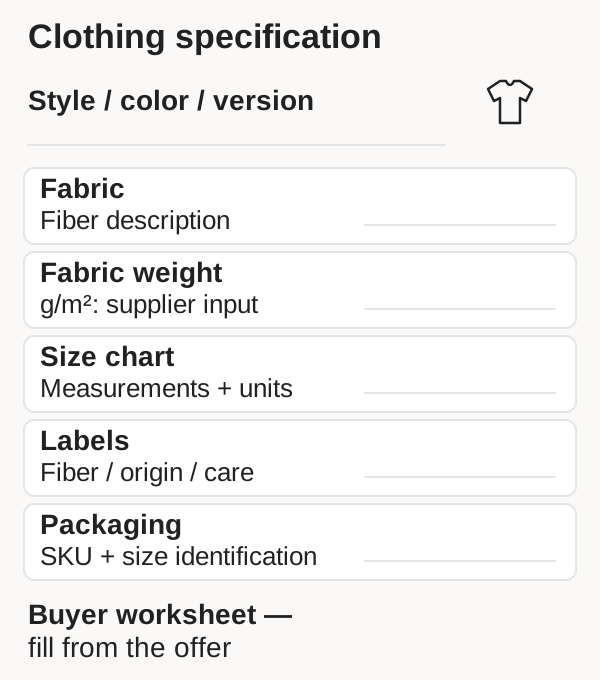
| Field | What to record | What remains to be agreed |
|---|---|---|
| Identity | Style/SKU, color reference, version and date | Whether photos and the quote show that version |
| Fabric | Fiber description, knit or woven construction, lining and trim | Evidence supporting composition claims |
| Fabric weight | Supplier-stated weight in g/m², if available | How it was determined and what is acceptable for this style |
| Size chart | Each offered size, garment measurements and units | Measurement points, flat versus circumference values, and agreed tolerances |
| Construction | Seams, hems, closures, pockets and visible finish | Which features the sample and shipment should match |
| Labels | Fiber, origin, business identification and care artwork | Placement, legibility and supporting care information |
| Packaging | SKU/size identification, unit packaging and carton contents | Any channel-specific packaging instructions |
| Order format | Selectable sizes or a fixed pre-pack | Actual units by style, color and size |
Fabric weight describes mass per area; it is not a quality score. Ask for it where it helps distinguish otherwise similar offers, but do not reject a garment against an unexplained universal weight threshold. Likewise, fiber composition alone does not establish opacity, fit, sewing quality or the correct care instruction.
For measurements, identify both endpoints. “Chest” could mean a width measured flat or a full circumference; writing the unit alone does not resolve the difference. Keep a marked sketch alongside the chart. Record the agreed allowance for a measurement difference rather than borrowing an internet tolerance for every style.
If a field is unknown, mark it for clarification. A quote that leaves fabric or size information open is not equivalent to one that includes it. Use the quotation request guide to carry the same specification and order breakdown into each request.
Common mistake: Comparing unit prices while one offer includes a fixed size pack and the other lets you choose sizes. Rewrite both offers as actual quantities before deciding which suits the order.
Takeaway: A useful specification names the garment, the measuring method and the unresolved terms; it does not fill gaps with assumed values.
Check labels and product-safety documents before approval
Review label information and product-safety requirements as separate checks. A correct-looking label does not prove safety compliance, and a product report does not replace the required garment disclosures.
For covered textile products, the Textile Fiber Products Identification Act and its implementing rules address fiber disclosure, origin and business identification. Request readable artwork and photographs showing the labels on the actual garment. The rules also address placement, including origin-label placement for garments with a neck.
The Care Labeling Rule applies to covered manufacturers and importers, including parties directing or controlling the manufacture or importation. It requires supported care information; its definition of a care label includes attachment and legibility over the product’s useful life. Ask what supports the proposed instructions rather than choosing washing language solely from the fiber name.
| Review item | Evidence to request | Decision before ordering |
|---|---|---|
| Fiber disclosure | Label text and composition information for the exact style | Resolve conflicting descriptions |
| Origin and business identification | Label artwork and photographs on the garment | Confirm the applicable disclosures and placement |
| Care instructions | Label text and its supporting basis | Resolve instructions that conflict with the garment or its components |
| General apparel safety | Identification of applicable rules and corresponding records | Check whether requirements or exemptions apply to this product |
| Children’s apparel | Product-specific testing/certification information, where applicable | Identify the responsible manufacturer or importer and match the documents to the product |
| Children’s sleepwear | Product classification and the applicable sleepwear records | Resolve sleepwear scope before treating it as ordinary clothing |
The CPSC’s Flammable Fabrics Act guidance addresses general wearing apparel as well as children’s sleepwear. Adult clothing therefore also needs a product-specific safety review; applicable testing and certification exceptions mean that you should not demand an identical certificate for every garment.
For children’s products subject to applicable safety rules, use the CPSC’s Children’s Product Certificate guidance to check product identification, applicable rules, responsible party and supporting records. Testing exemptions or determinations need their own basis. A document covering a different garment is not evidence for the style in your order.
Children’s sleepwear needs a separate classification check under the applicable rules, including Part 1615 and Part 1616. Describing an item as “loungewear” is not a substitute for checking how the rules define the product. Take unresolved classification and document questions to the responsible party or a qualified product-safety specialist before approving the order.
Takeaway: Check the garment disclosures and applicable safety records independently, with documents that identify the product you intend to buy.
Review a sample against the recorded specification
Use a sample to record observable differences from the specification. Keep those observations separate from laboratory results, regulatory documents and claims about the whole shipment.
Ask whether the sample comes from the available stock or represents intended production. Record its style, color, size and date received. If it is a development sample, note which features remain subject to change. A photograph cannot answer whether the piece you handle matches the proposed bulk order.
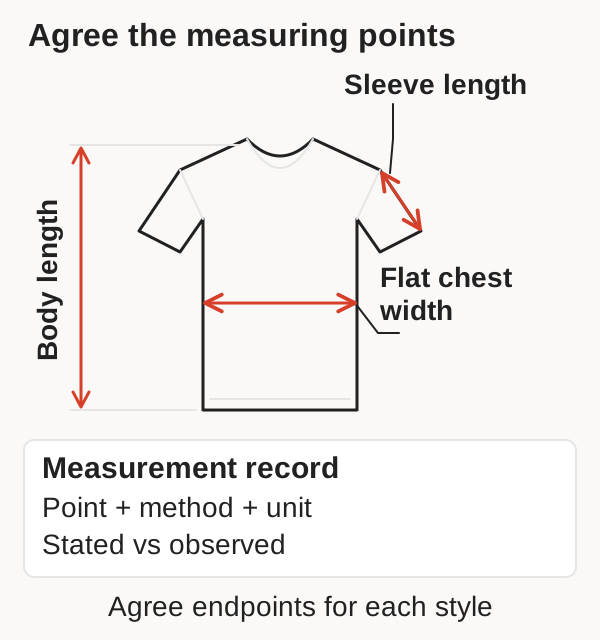
Inspect the garment alongside the sheet. Record seam and hem appearance, closures, visible fabric defects, lining and label attachment. Compare color and finish with the agreed reference. Turn adjectives such as “premium” or “trendy” into specific questions: which fabric, which finish, which actual style, and which available sizes?
Measure the agreed points using the same method and units as the chart. If the supplier’s chart gives body measurements rather than finished-garment measurements, identify that distinction before interpreting a difference. Do not convert a fit preference into a defect without a stated garment specification.
| Sample record | What to write down |
|---|---|
| Reference | Style, color, size, specification version and sample status |
| Measurements | Point, method, unit, stated measurement and observed measurement |
| Appearance | Photos of the feature or difference being discussed |
| Care observation | Instructions followed, conditions used and any visible change |
| Seller response | Clarification, corrected specification or proposed remedy |
| Decision | Accepted feature, unresolved difference or reason to stop |
Where appropriate, follow the supplied care instructions and record what you did and observed. Changes in dimensions, color or finish are reasons to investigate; this home or buyer observation is not a standardized test or a complete basis for a compliance claim. Ask for appropriate testing when the decision depends on a property you cannot establish by inspection.
Retain an agreed reference sample or a clear record identifying it. Ask how differences in the delivered stock will be assessed and reported. Sample approval is useful only if both parties understand what has been approved and how it relates to the shipment.
Takeaway: Leave the sample review with a dated observation record and a written resolution of differences, not an unsupported claim that the bulk stock will be identical.
Plan the first size run around evidence
Choose quantities by style, color and size, and distinguish a fixed pre-pack from individually selectable sizes. There is no size ratio established by this guide that fits every customer group or garment.
A size run is the set of sizes and quantities within an order. In a pre-pack, the seller fixes its contents; with selectable sizes, the buyer can specify quantities. Ask for the actual contents rather than relying on a photograph showing the available size labels.
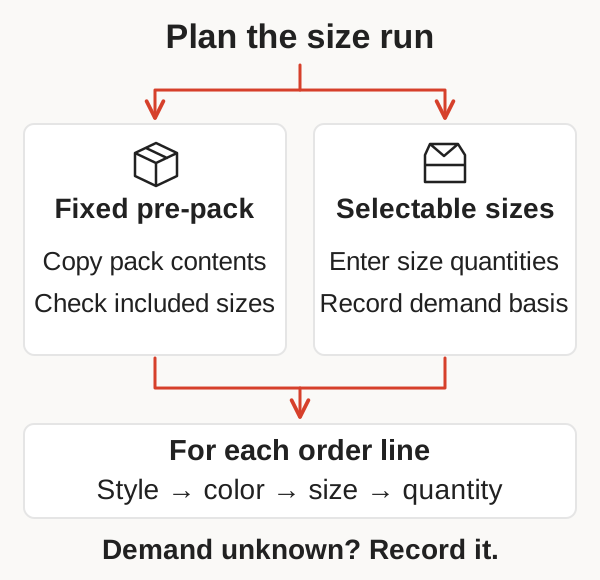
If you have sales records, use the closest comparable garment and customer group to inform a proposed mix. Record why the comparison is relevant. A different fit or size chart may make past labels an unreliable guide, so compare measurements as well as the letters printed on the tag.
Without sales evidence, record demand as unknown. Consider an order whose exposure you can manage and whose sales can teach you something useful, rather than treating the seller’s pack as a demand forecast. This is a planning recommendation, not a promise that a small trial will sell or that the seller permits one.
| Planning field | Fixed pre-pack | Selectable sizes |
|---|---|---|
| Units by style, color and size | Copy the seller’s pack breakdown | Enter proposed quantities |
| Demand basis | Compare each included size with available evidence | Record the evidence behind each requested size |
| Uncertain sizes | Identify stock you may struggle to sell | Keep assumptions visible before committing |
| Reorder route | Ask whether the same pack will remain available | Ask whether individual sizes can be replenished |
| Order change | Confirm whether pack contents can change | Confirm the final allocation in writing |
Use the MOQ negotiation guide when asking whether the seller can change the order structure. Clarify whether its minimum applies to the whole order, a style, a color or a pack. Do not assume that a lower overall minimum gives you freedom to select every size.
Common mistake: Treating the supplier’s pack ratio as evidence of your customers’ demand. The pack defines what you buy; your records need to establish why that mix suits your store.
Keep availability and replenishment questions alongside quantity decisions. The ecommerce sourcing overview covers the broader relationship between sourcing and repeat orders; here, record whether the garment and sizes being approved can be requested again.
Takeaway: Make every committed unit visible by style, color and size, with demand assumptions and reorder questions recorded separately.
When this does not apply
Use a different review when the product, market or decision falls outside this guide’s scope. Its worksheets support purchasing judgement; they do not certify a garment or establish a business’s permission to sell it.
- Used or mixed secondhand clothing: condition grading, sorting and the applicability of labeling rules need separate review. This workflow assumes new garments described by a defined style and specification.
- Markets outside the US: confirm local labeling and safety requirements rather than applying the US sources here as universal rules.
- Children’s clothing or sleepwear: complete the product-specific safety review before ordering. The regulatory section identifies a branch to investigate, not every obligation or exemption.
- A claim requiring test evidence: visual inspection cannot establish fiber composition, flammability or every performance property. Obtain appropriate evidence for the actual claim.
- Bulk acceptance: a sample observation alone does not establish that an entire shipment meets the agreed specification. Define the inspection and defect process separately.
Return to the industry sourcing overview if you are comparing clothing with other product categories. This page does not recommend which category to enter or promise that an apparel business will be profitable.
Takeaway: Keep the worksheets within their purchasing scope and resolve specialised product or market requirements before proceeding.
Put the first order into a written record
Turn the agreed evidence into an order record that both parties can identify. Do not leave a resolved sample issue, changed label or substituted size pack only in an informal conversation.
Before committing, check the following against the quotation or proposed purchase order:
- Selling entity and the party receiving payment.
- Exact style and color identifiers, with quantities for every size.
- Specification version, measurement chart and agreed sample reference.
- Approved label artwork and the product documents still required.
- Packaging and carton breakdown that preserve size/SKU identification.
- Confirmed stock or production status and the agreed delivery terms.
- Payment terms, defect reporting process, return conditions and any agreed remedy.
- Remaining questions, named responsible party and written resolution.
If the quote and specification disagree, obtain a corrected record before treating the offer as ready. If a document cannot be matched to the garment, pause that approval rather than filling the gap with a verbal assurance. The output of this guide is an order you can describe and check, not merely a vendor you have contacted.
For cost comparison, the wholesale buying guides explain the wider cost and trade-term questions. A clothing quote also needs its size quantities and packaging visible so that a low unit price is not mistaken for a suitable first commitment.
Takeaway: Carry the garment specification, approved references and exact size allocation into the same written transaction record.
Method and sources
The legal references below are government statute, rule and agency-guidance sources accessed on October 8, 2026. They support the product-label and safety questions stated here; they do not establish that any vendor or garment complies.
The route comparison, specification fields, sample record and size-planning tables are editorial recommendations developed for this guide. They contain no supplier case, measured test result, standard inspection threshold or assumed size ratio. Fill them with information for your own offer. Questions about legal applicability need the relevant rule and responsible authority, not a checklist tick.
The FAQ uses questions captured in a US English search-results snapshot on October 6, 2026. Responses stay within this page’s evidence and scope; no website, garment category or business form is declared universally best.
Takeaway: Use the official sources to verify rule scope and the worksheets to document the purchasing decision.
Related reading
- Verify a wholesale supplier — Check the counterparty before relying on its garment offer.
- Quotation comparison inputs — Carry the same garment inputs into each quote request.
- Negotiate order minimums — Clarify what the minimum applies to before requesting a different size mix.
Takeaway: Use these guides for identity, quote format and minimum-order questions once the clothing inputs are recorded.
Frequently asked questions
What is the best website for wholesale clothing?
This guide does not rank websites. Check who actually sells and invoices the goods, whether the exact style and size run are available, and what sample, labeling and defect documents you can obtain. A useful website helps you verify those items rather than substituting a platform badge for product evidence.
Where can I buy wholesale clothes to resell?
Candidate routes include stocking wholesalers, brand or showroom contacts, manufacturers and wholesale websites. Ask whether the offer is existing stock, a future delivery or custom production, and identify the actual seller before comparing styles. These are route categories, not approved vendor recommendations.
Can I buy wholesale clothing without a license?
Ask the seller for its account requirements, and check the tax and business rules with the relevant state authorities. This guide cannot determine whether your business needs a particular permit or resale document. A supplier accepting payment does not resolve your legal or tax obligations.
Can I legally resell clothes?
This guide cannot clear a particular garment or business for resale. Check the applicable business and tax requirements, product labeling and safety rules, brand-related permissions and your sales channel's rules. An invoice or a care label alone does not settle all of those questions.
What type of clothing is most profitable?
There is no category winner established by the evidence in this guide. Compare your own expected sales with the full order cost, unsold sizes, defects and returns. A low unit price or a trend claim is insufficient to predict profit, particularly when a fixed pack forces you to buy sizes you cannot yet forecast.
Can a normal person buy from a wholesaler?
Check the wholesaler's account terms and required documents directly. Do not assume that a publicly visible catalogue means everyone can open an account, or that buying access settles the requirements for operating a retail business. Clarify account eligibility before paying for samples or planning a size run.
Sources
- Textile Fiber Products Identification Act — misbranding provisions — U.S. Government Publishing Office Accessed October 8, 2026.
- Rules under the Textile Fiber Products Identification Act — 16 CFR Part 303 — Electronic Code of Federal Regulations Accessed October 8, 2026.
- Care Labeling Rule — 16 CFR Part 423 — Electronic Code of Federal Regulations Accessed October 8, 2026.
- Flammable Fabrics Act — apparel and children's sleepwear guidance — U.S. Consumer Product Safety Commission Accessed October 8, 2026.
- Children's Product Certificate — product identification and supporting records — U.S. Consumer Product Safety Commission Accessed October 8, 2026.
- Children's sleepwear standard — 16 CFR Part 1615 — Electronic Code of Federal Regulations Accessed October 8, 2026.
- Children's sleepwear standard — 16 CFR Part 1616 — Electronic Code of Federal Regulations Accessed October 8, 2026.
- Certificates of Compliance — 16 CFR Part 1110 — Electronic Code of Federal Regulations Accessed October 8, 2026.