Direct answer
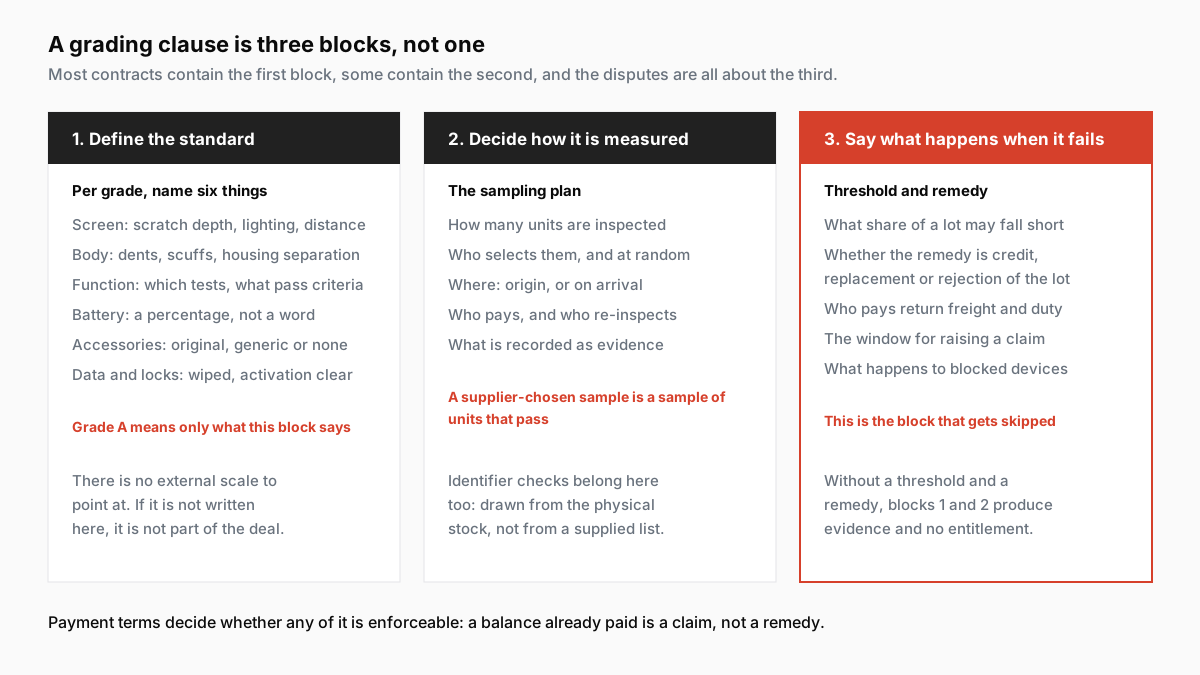
There is no industry-wide definition of a handset grade, so a grading standard is something you write rather than something you cite. An enforceable one has three parts: per-grade criteria covering screen, body, function, battery, accessories and data state; a sampling plan that says who inspects how many units and where; and a rejection threshold with a stated remedy. Contracts routinely contain the first part and fail on the third.
Key takeaways
- A grade is a contractual term, not an industry standard, so the contract has to define it.
- Battery health belongs in the clause as a percentage with a test method, not as a word.
- A sample the supplier selects is a sample of units that pass, whatever the sampling ratio.
- Without a rejection threshold and a remedy, criteria and inspection produce evidence but no entitlement.
- Data sanitisation and activation lock are pass-or-fail conditions rather than cosmetic grades.
Every dispute over a handset lot is the same dispute. The buyer says the goods are not as described; the seller says they are Grade A; and neither party can point to a document that settles what Grade A meant. The problem is not dishonesty on either side. It is that the term carries no external definition, so both parties supplied their own and only discovered the gap after payment.
The scale is yours to write
A grade is shorthand for a set of conditions. Larger refurbishers publish house standards and apply them consistently, which is genuinely useful — but a house standard binds the house that wrote it, not your supplier. Between two counterparties the operative definition is whatever the purchase agreement contains, and if the agreement contains nothing, the operative definition is whatever arrives.
This is why the category rewards paperwork more than negotiation. A better price on an undefined grade is not a better deal.
Six attributes a grade has to name
Per grade, and in the contract rather than in an email thread:
- Screen condition. Scratch depth and visibility, assessed under stated lighting and at a stated distance. Without those two qualifiers the criterion is an opinion.
- Body condition. Dents, scuffs, housing separation, and whether the frame may show machining marks from a repair.
- Functional test scope. Which components are tested — cameras, speakers, microphones, charging port, wireless radios, sensors, biometrics — and the pass criteria for each.
- Battery health. A percentage, with the method used to read it and whether replaced cells are permitted.
- Accessories and packaging. Original, generic, or none, and whether packaging condition affects the grade.
- Data and lock state. Wiped to a defined standard, and confirmed clear of activation lock.
The last one is not cosmetic and should not be graded on a scale. A device still linked to a previous owner’s account cannot be set up by your customer, which makes it unsellable regardless of how it looks.
Weak clause, enforceable clause
| Attribute | What contracts usually say | What can be enforced |
|---|---|---|
| Screen | Minor scratches | No scratch visible at 30 cm under office lighting |
| Battery | Good battery health | Minimum 85 percent, measured by the handset’s own diagnostic |
| Function | Fully working | Named test list, each with a pass criterion |
| Data | Wiped | Sanitised to a named standard, evidenced per unit |
| Accessories | Complete | Original charger and cable, retail box, or stated substitute |
| Shortfall | As described | Above 3 percent of the lot below grade, buyer may reject the lot |
The right-hand column is not longer because it is pedantic. It is longer because each line has to survive being read by someone who disagrees with you.
Sampling decides what the criteria are worth
Criteria describe units. A sampling plan is how you learn whether the lot matches them.
- State the sample size as a number or a formula, not as a proportion left to judgement.
- Select the units yourself, or through an inspector you appointed. A supplier-prepared sample is a sample of units that pass, and this is true even when the supplier is honest, because nobody volunteers their worst boxes.
- Fix the location. Inspection at origin lets you reject before freight; inspection on arrival only works if money is still outstanding.
- Record the result in a form that can be produced later: photographs against the criteria, identifiers of the units sampled, the date and who performed it.
Provenance checks belong inside the sampling plan rather than alongside it, drawn from the physical stock in front of you. What such a check does and does not establish is set out in IMEI checks for wholesale phone buyers.
The threshold and the remedy
This is the block that gets left out, and it is the only one that converts a finding into an entitlement.
- The threshold. What share of the lot may fall below grade before the lot itself is at issue. Some shortfall is normal; the clause exists to distinguish normal from material.
- The remedy above it. Credit against the invoice, replacement units, re-grading at a lower price, or rejection of the whole lot. Name which, and who chooses.
- Freight and duty on returns. Frequently more than the recovery on low-value handsets, which is why credit is often the sensible remedy rather than physical return.
- The claim window. How long after delivery a claim can be raised at all.
- Blocked devices after delivery. An identifier can be reported after you buy, so agree in advance what happens if a device is blocked within a defined window.
None of it works if the money has already gone. Holding a balance against inspection rather than against shipping documents is what gives the clause force, and the mechanics are in buying guides.
Data sanitisation is a criterion, not an assurance
Devices that were not properly wiped carry a customer-experience problem and a data protection exposure, and both land on the seller who shipped them.
NIST’s Guidelines for Media Sanitization describe sanitisation in terms of the level of effort applied and the assurance it provides, which is the useful framing for a contract: name the standard the supplier applies, require it per unit rather than per lot, and verify it on your sample instead of accepting the statement. Where volume justifies it, retain the evidence.
Where to go next
For how grading interacts with the three stock tiers, see new vs used phones for wholesale buyers. For the category overview and where secondary stock originates, see mobile phones. For the counterparty checks that precede any of this, see how to verify a wholesale supplier.
Frequently asked questions
Is there an official standard for phone grades?
No single scale governs the trade. Some larger refurbishers and marketplaces publish their own definitions and apply them consistently, but those are house standards rather than an external authority. Between two counterparties, the only definition that binds is the one in the purchase agreement.
What battery health threshold is reasonable?
The number matters less than stating one. Pick a percentage that suits your channel, name the measurement method, and make units below it a defect rather than a discount. A grade that says good battery is unenforceable, whatever percentage both parties had in mind.
Should inspection happen at origin or on arrival?
At origin where the order value justifies it, because rejecting goods before they ship is far cheaper than returning them afterwards. On arrival is workable for smaller lots, but only if the payment terms leave something unpaid at that point.
Sources
- SP 800-88 Rev. 1, Guidelines for Media Sanitization — National Institute of Standards and Technology
- IMEI Database (Device Check) — GSMA